
Attention as Capital: How Your Brain Allocates Focus and How to Stop Leaking It

TL;DR
Attention is your most precious resource, energy and time support it but attention is what shapes your world. Three distinct brain networks (alerting, orienting, executive control) manage this capital, but modern digital environments systematically drain it through multitasking costs, notification interruption, and cognitive overload. Reviews of task switching show that frequent switching reliably slows performance (studies have suggested up to 40% of a knowledge workers time is spent context switching) and increases errors, which can erode a large fraction of potential productive capacity under heavy multitasking conditions.
This article breaks down the neuroscience of attention and provides five evidence‑based protocols to reclaim, protect, and strategically deploy your attention capital. Would you let your company’s resources be drained by non-specific sinks that don’t contribute to the overall goals and bankrupt the company? Don’t let it happen to your attention.
Why your attention is more valuable than your time
You have 1,440 minutes in a day, but only about 4–6 hours of high‑quality attention. Attention is finite, fragile, and non‑renewable within each day. Every notification ping, context switch, and multitasking moment not only steals valuable seconds but it also degrades and depletes your cognitive capital.
In modern work we like to say that time and energy are our most precious resources. They matter, but they are not the real bottleneck. You can have a clear calendar, a double shot of espresso, and feel like you can conquer the world and still get nothing meaningful done if your attention is fragmented. What actually drives your results is how much high‑quality, undivided attention you can bring to the small number of things that matter and how long you can sustain that attention.
The challenge is that you are not the only one trying to direct that attention. Hundreds of companies explicitly build their business models around capturing and monetising your focus. This “attention economy” means sophisticated product teams are constantly designing notifications, feeds, and interfaces to hijack the same neural systems you rely on for deep work. If you do not actively protect and train your attention, you are effectively bringing a knife to a gunfight.
The solution is not to become a monk and delete every app and unplug all flashing lights, but to understand how your attention systems actually work and then design your environment and habits so you are the one choosing where your focus goes.
The neuroscience is clear: your brain operates three distinct attention networks, each with specific functions and vulnerabilities. A seminal review of this system is here. Master these systems and you gain more control over your scarcest resource. So, grab a coffee and let’s dive in!
The neural architecture: your brain’s attention operating system
The three networks that control your focus
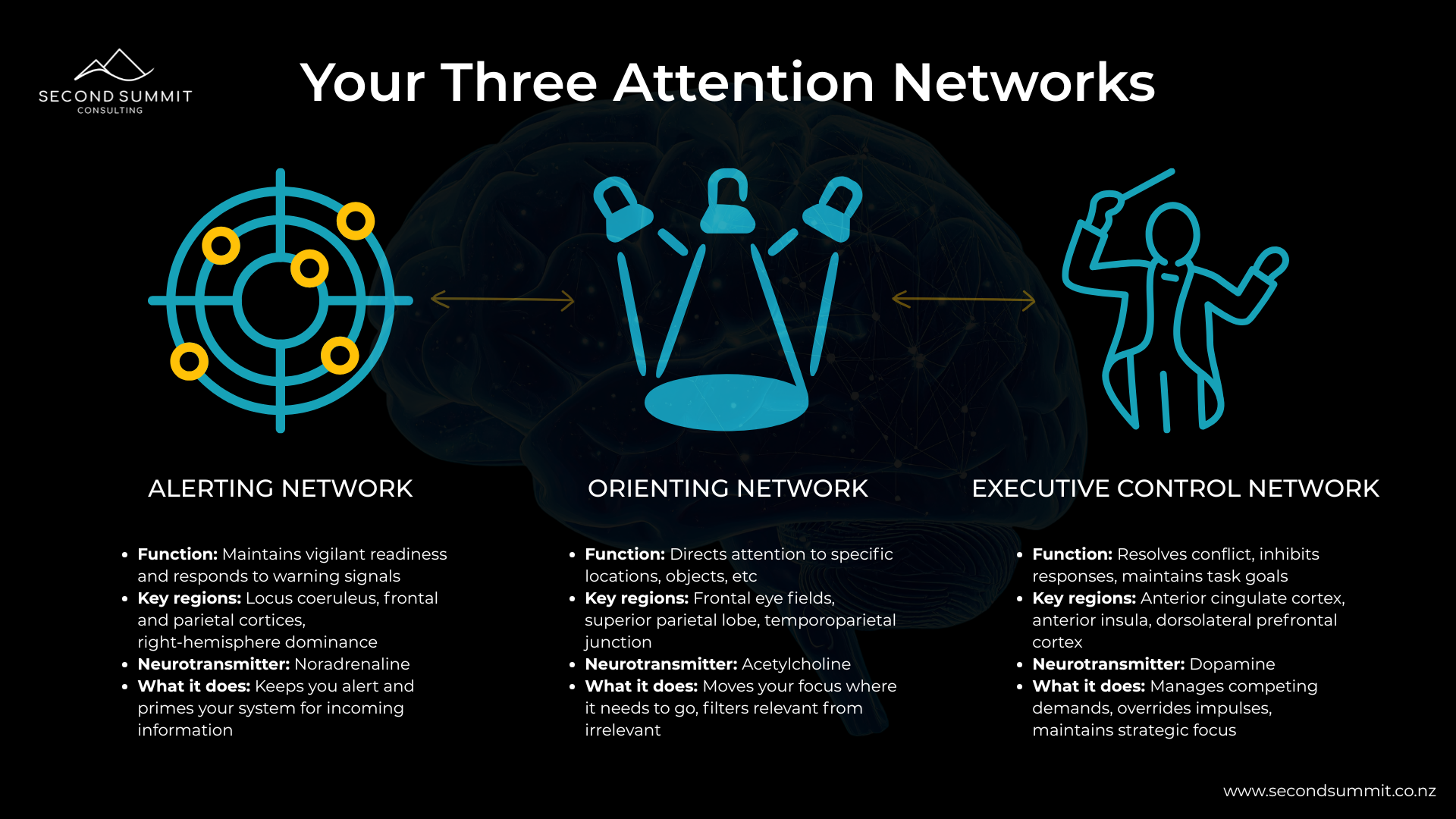
Your attention is not a single system, it is three specialised networks working together, each with distinct neural mechanisms and functions. This tripartite model is laid out in detail here. Here is a simplified summary:
1. The alerting network: your cognitive early‑warning system
- Function: Maintains vigilant readiness and responds to warning signals
- Key regions: Locus coeruleus (which we touched on in my recent noradrenaline primer), frontal and parietal cortices, right‑hemisphere dominance
- Neurotransmitter: Noradrenaline
- What it does: Keeps you alert and primes your system for incoming information
2. The orienting network: your attention spotlight
- Function: Directs attention to specific locations, objects, or sensory modalities
- Key regions: Frontal eye fields, superior parietal lobe, temporoparietal junction
- Neurotransmitter: Acetylcholine
- What it does: Moves your focus where it needs to go, filters relevant from irrelevant
3. The executive control network: your cognitive CEO
- Function: Resolves conflict, inhibits dominant responses, maintains task goals
- Key regions: Anterior cingulate cortex, anterior insula, dorsolateral prefrontal cortex
- Neurotransmitter: Dopamine
- What it does: Manages competing demands, overrides impulses, maintains strategic focus
These networks can be distinguished functionally and anatomically, which is why you might be alert but unable to focus (alerting without executive control), or focused on the wrong thing (executive control without effective orienting). A good overview of how these networks are measured and dissociated behaviourally is here (paywalled).
The salience network: your attention traffic controller
Working alongside these three networks is your salience network: an anterior insula and anterior cingulate system that decides what deserves your attention. Think of it as your brain’s bouncer, the big burly chap at the front door determining which stimuli get past the velvet rope into conscious awareness. A detailed network model is discussed here.
When functioning well, this system filters out irrelevant distractions and amplifies important signals and directs high-quality, sustained focus. When overwhelmed or hijacked, it becomes hypervigilant, treating every notification as urgent and every interruption as critical, putting you on edge and fragmenting focus.
The modern attention crisis: how digital environments hijack your networks
The multitasking myth and switch costs
Multitasking in the way we usually mean it is neurologically impossible. For most cognitively demanding tasks, the brain switches rapidly between them, and each switch carries a cost in time and errors.
A classic review on task switching and its costs is here. A more accessible summary from the American Psychological Association is here. Both show that:
- People are slower and make more errors when switching between tasks
- These “switch costs” increase as tasks become more complex
- Frequent switching can cumulatively consume a large portion of available productive time
Every time you check Slack/Teams mid‑spreadsheet or answer a call during deep work, you are not just losing that time. You are paying switch costs that can leave you mentally scattered and slow to recover.
The notification trap: hijacking your salience network
Your phone buzzes. Your brain’s salience network flags this as potentially important, triggering an orienting response and recruiting executive control to either check or inhibit checking.
Several studies show that smartphone notifications disrupt attention and performance even when people do not actively use the phone. For example, receiving smartphone notifications impaired cognitive control and attention on an attention‑demanding task in this study here. A broader review of smartphones and cognition, including acute distraction effects, is here.
There is also evidence that the mere presence of a smartphone can reduce baseline attentional performance, even when it is not being used, as shown here.
Your salience network, evolved to detect genuine threats, cannot tell the difference between a sabre‑toothed cat and a Teams ping. Both trigger “pay attention now”.
The cognitive load ceiling
Your working memory, your brain’s RAM, can only hold a limited number of information chunks at once. Contemporary cognitive load theory and experimental work suggest a practical capacity of roughly three to five meaningful elements, depending on complexity and expertise. A concise introduction to cognitive load theory can be found here.
Modern knowledge work easily exceeds this capacity through:
- Multiple open browser tabs and applications
- Constant context switching between projects
- Information overload from email, chat, and documents
- Decision fatigue from endless micro‑choices
When cognitive load exceeds capacity, your executive control network becomes overwhelmed. Load theory work shows that high perceptual or cognitive load impairs selective attention and control, producing exactly the “fried but not physically tired” feeling many knowledge workers recognise. A core paper on load theory and selective attention is discussed here.
Five evidence‑based protocols to reclaim your attention capital
Protocol 1: network‑specific attention training
The science
The three attention networks can be probed and modified through targeted tasks. The Attention Network Test (ANT) is one standard way to measure the efficiency of alerting, orienting, and executive control in a single paradigm, described here and used across many populations here. This work shows that these components are dissociable and trainable to some extent.
The science has shown these networks are trainable to increase effectiveness and efficiency. While you are not doing lab‑grade training at home, you can deliberately recreate the same underlying cognitive demands and strengthen those cognitive muscles.
Alerting network training (5 minutes daily)
Focus: Build sustained alertness and readiness to respond.
- Set up a simple “vigilance” drill during a 10–15 minute block. Use a timer or app that gives signals at random intervals (for example, every 2–8 minutes).
- Each time it sounds, respond as fast as you can (tap the desk, press a key) and then quickly rate your alertness from 1–10.
- Track these ratings across days to see when your alerting system tends to be sharp or dull.
This drill mirrors the logic of the psychomotor vigilance task (PVT), a sustained‑attention reaction time test where people respond to simple stimuli that appear at unpredictable intervals. PVT is considered a leading assay of sustained vigilant attention, highly sensitive to sleep loss and circadian misalignment (see overviews here and here). You are recreating the same “stay ready for an unpredictable event” demand that engages the alerting network.
Orienting network training (10 minutes daily)
Focus: Improve how quickly and precisely you can shift the “spotlight” of attention.
- Place two small objects at the far left and right edges of your visual field while you sit comfortably.
- Fix your gaze roughly in the middle. Every 10–20 seconds, deliberately shift your attention (not your eyes, if possible) to one object and hold detailed focus on it (shape, texture, colour) for a few seconds, then shift to the other.
- Gradually increase the speed and precision of your shifts while keeping your gaze relaxed.
This is an applied analogue of spatial cueing paradigms such as the Posner cuing task. In these tasks, cues direct attention to a location before a target appears, and responses are faster and more accurate for cued locations. A historical and current overview of orienting is given here. Your drill deliberately trains voluntary control of where that spotlight goes and how quickly it can be moved.
Executive control training (15 minutes daily)
Focus: Strengthen conflict monitoring, inhibition, and working memory.
- Conflict drills (Stroop‑style). Spend 5–10 minutes on tasks where you must override an automatic response, such as naming the ink colour of colour words when the word and colour conflict. The Stroop task is a standard tool to probe selective attention and executive control; discussions of its use in training and assessment are available here and here.
- Working memory challenges. Do brief bouts where you hold small amounts of information in mind while doing another task, such as remembering a 3‑item sequence while performing mental arithmetic, or simple n‑back exercises. Dual n‑back working memory training has been shown to improve performance on the trained task and to produce some transfer to related executive functions, although the extent of generalisation is debated (see examples here and here: dual n‑back review, capacity increase study).
Repeated practice with conflict and working memory tasks produces measurable performance gains on those tasks and some improvements in related executive‑function measures, including in clinical populations (for example ADHD training work discussed here and here). Realistically, you are directly training known executive‑attention mechanisms; you should expect improvements on similar tasks and some spillover to complex work, but not a global cognitive upgrade.
Expected outcome: Better subjective control over focus and less “slippage” on tasks within 2–3 weeks, with more noticeable performance changes on structured tasks over 4–6 weeks.
Protocol 2: environmental design for attention protection
The science
Your physical environment shapes how hard your attention networks need to work. So called ‘biophilic workplace design’ studies show that incorporating natural elements (plants, views, natural materials) is associated with better cognitive performance, lower stress, and improved perceived productivity compared with more sterile environments (see examples here and here).
At the same time, cluttered or noisy environments increase cognitive load and attentional strain, as discussed in applied neuroscience of workspace design (for a couple of accessible overviews, see here and here).
The protocol
Stimulus control architecture
- Single‑purpose spaces. Where possible, designate particular areas or setups for specific types of work (for example, a “deep work” desk with only the tools you need for focused tasks).
- Visual field management. During focus blocks, keep only task‑relevant material in your immediate visual field. Remove or cover peripheral clutter that competes for attention.
- Lighting optimisation. Use brighter, cooler light during alertness‑heavy work periods, and warmer, dimmer light for low‑stakes creative thinking or winding down.
Attention‑restoration elements
- Nature integration. Add plants, images of natural scenes, or views of real greenery to your workspace. Studies examining plants and other biophilic elements in offices find positive effects on attention, mood, and perceived productivity (discussed here and here).
- Soft‑fascination objects. Include items that gently hold attention without demanding effort, such as an aquarium, a view of trees, or a simple piece of art. These support the kind of involuntary attention that allows directed attention systems to rest, consistent with attention restoration theory (for more reading see here).
- Natural textures and materials. Where you can, favour wood, fabric, or other natural finishes over harsh synthetic ones.
Digital environment design
- Notification architecture. Batch notifications to specific times (for example, 10:00, 14:00, 17:00) and mute them during deep work blocks, reducing externally triggered task switches. Evidence that notification‑driven interruptions harm performance is reviewed here and here. If your team might need to contact you, create an emergency escalation protocol so you know you can be contacted in emergencies and your team feels supported.
- App organisation. Group similar apps together in a folder and put them on the last homescreen possible and remove highly salient icons from your home screen.
- One task-One workspace. Use separate browser profiles for focused work vs everything else, and limit the number of open tabs during deep work. Extend this to all software, only keep open the software required for the task at hand and close all others.
Expected outcome: Noticeable reduction in “background distraction” and improved ability to stay with a task within days, with further gains as your brain learns that certain spaces and setups reliably signal “focus mode”, it’s like Pavlov’s dogs but less clean up.
Protocol 3: strategic attention restoration
The science
Attention restoration theory proposes that certain kinds of environments, especially natural ones that gently engage involuntary attention, help restore depleted directed attention systems. A good conceptual overview is here and a critical discussion of the theory is here.
We now have direct experimental evidence that even very short nature‑based micro‑breaks can improve subsequent sustained attention. In a study published in the Journal of Environmental Psychology, 150 students performed a sustained attention to response task, took a 40‑second micro‑break viewing either a flowering meadow green roof or a bare concrete roof, then repeated the task. Those who viewed the green roof made significantly fewer omission errors and showed more consistent responding than those who viewed concrete.
The protocol
Daily micro‑restorations (40–60 seconds)
- Once or twice per hour, take a 40–60 second micro‑break. Look away from your screen at trees, sky, a garden, or even a photo or video of a natural scene.
- Let your gaze and attention rest lightly on the scene without trying to analyse it.
You are recreating, in your environment, the conditions of the green‑roof experiment that boosted sustained attention after just 40 seconds of viewing.
Weekly deep restoration (2+ hours)
- Schedule at least one weekly block of 2+ hours in a natural setting, without digital devices.
- Spend this time in low‑effort, gently engaging activities (walking, easy conversation, simple exploration), rather than goal‑driven productivity.
A recent quantitative review of nature exposure and attention restoration suggests that nature is generally more restorative than non‑nature environments for cognitive capacity, with benefits depending on exposure duration (see paper here). Effects are modest but meaningful and appear strongest when people start out mentally depleted.
Attention‑recovery indicators
- Improved ability to stay with boring but necessary tasks
- Reduced mental fatigue after cognitively demanding work
- Increased creativity and problem‑solving capacity after breaks
Expected outcome: You can feel the effects of a single well‑designed micro‑break immediately; consistent practice across 2–3 weeks builds a noticeable increase in “mental stamina”.
Protocol 4: notification and interruption management
The science
Interruption and smartphone research converges on a clear message: notifications and task interruptions harm performance and increase cognitive strain, even when people do not actively engage with the device.
One study using a Navon letter task found that smartphone notification sounds impaired cognitive control and attention, even when participants did not interact with the phone (paper here). A broader review of smartphones and cognition, covering acute distraction and longer term associations with attention, is here. This study on “mere presence” of smartphones and attentional performance found that “the mere presence of a smartphone results in lower cognitive performance” .
Field experiments in workplaces show that reducing or batching notifications and interruptions can improve performance and reduce strain (for some examples, interruptions from messaging platforms studied here and more general interruption research reviewed here).
The protocol
Notification batching system
- Set 2–3 communication windows in your day (for example, 09:30, 13:00, 16:30) where you process email and messages.
- Outside those windows, mute non‑urgent notifications and keep your phone out of your immediate visual field.
- Agree clear “true emergency” channels with your team or family.
Interruption firewall
- Use physical signals such as closed doors, headphones, or a visible “focus time” sign to indicate unavailability. This is especially important for open-plan offices.
- Block “office hours” in your calendar for colleagues who need you, rather than allowing constant ad‑hoc interruptions.
- Protect at least one 60–90 minute deep work block per day where interruptions are the rare exception, not the rule.
Recovery protocols
- After an unavoidable interruption, take 30 seconds for a simple breathing reset (slow inhale, slower exhale) before resuming work.
- Briefly reconstruct context: write one sentence about what you were doing and what the next step is.
- Do a 1–10 attention check: if you are below a 5, consider a 40‑second nature micro‑break (Protocol 3) before diving back in.
Expected outcome: Reduced interruption frequency and a noticeable increase in completed deep work sessions within 1–2 weeks, plus lower end‑of‑day mental exhaustion.
Protocol 5: circadian‑aligned deep work architecture
The science
Cognitive performance, including attention, follows circadian rhythms and varies with chronotype and time awake. People tend to perform best on demanding tasks when they work during their biological “day” and worse when tasks fall in their biological “night”. Reviews on circadian rhythms and cognition, and the impact of sleep and circadian misalignment on attention and executive function, are summarised in the sleep and circadian literature (for an accessible overview, see my cortisol primer here and broader chronobiology reviews in clinical sleep texts).
The protocol
Chronotype assessment
- For one week, briefly rate your alertness and focus every 1–2 hours.
- Identify the 2–3 hour windows where you consistently feel most mentally sharp.
- Mark these as your “prime cognitive hours”.
I have created a chronotype assessment tool that uses academically validated questions to calculate your chronotype and indicates your biological ‘days’ and ‘nights’. Email me if you want access for free.
Deep work scheduling
- Reserve prime hours for your highest‑stakes thinking: strategy, writing, design, complex problem solving.
- Push shallow work (email, admin, routine meetings) into your lower‑energy windows.
- Build 10–15 minute buffers between deep work blocks and other activities so your brain can switch modes.
Circadian support
- Get 10–15 minutes of outdoor light within about 30 minutes of waking to help anchor your circadian clock for the next day.
- Use brief movement (a short walk, a few flights of stairs) during your post‑lunch dip to raise alertness without relying solely on caffeine.
- Dim lights and reduce bright screen exposure 1–2 hours before bed to protect sleep quality, which directly feeds into next‑day attention capacity.
Expected outcome: Within 1–2 weeks you should notice that your most important work feels less effortful and that you make fewer mistakes when your tasks are aligned with your natural peaks.
Implementation strategy: building your attention capital
Start with your biggest leak
Do not try to implement all five protocols at once. Instead, identify your primary attention drain:
- Constant interruptions? Start with Protocol 4
- Afternoon crashes? Begin with Protocol 5
- Cannot sustain focus? Try Protocol 1
- Distracting environment? Implement Protocol 2
- Feel mentally “fried” despite breaks? Tighten Protocol 3
Track your attention metrics
Monitor:
- Sustained attention span: How long can you stay with a boring but important task?
- Switch recovery time: How quickly do you refocus after an interruption?
- End‑of‑day capacity: How much high‑quality thinking can you still do at 17:00?
- Deep work: Number and duration of uninterrupted focus blocks per week
Progressive overload for attention
Treat this like training:
- Week 1–2: Establish your first protocol and baseline measurements
- Week 3–4: Increase difficulty or duration of that protocol
- Week 5–6: Add a second protocol
- Week 7–8: Refine based on your data and add a third if helpful
What to expect: realistic timeline for attention recovery
- Days 1–7: You notice how fragmented your attention really is. Implemented changes feel slightly effortful.
- Weeks 2–4: Clear improvements in sustained focus and less “attention crash” late afternoon.
- Months 2–3: Significant gains in cognitive capacity, deeper work outputs, and firmer work–life boundaries.
You are rewiring attention habits shaped by years of digital distraction. Expect resistance, but also expect compounding gains.
The bottom line
Your attention is your most valuable cognitive asset, but modern environments are designed to capture and fragment it. The neuroscience shows three core attention networks and a salience system that can be trained and protected with targeted protocols.
You do not need superhuman willpower or another productivity app. You need a realistic understanding of how your attention systems work and a willingness to design your calendar, environment, and habits so they work with your brain, not against it.