
Beyond Fight-or-Flight: Training Your Brain's Primary Arousal System for Sustained Peak Performance

That 3pm energy crash during your critical board meeting? The hypervigilance keeping you awake at 2am? Both could be driven by the same molecule: noradrenaline. Today in our journey of peak performance neurochemistry we will look at dopamine's cousin, noradrenaline (AKA norepinephrine). Like dopamine, noradrenaline is also a catecholamine and is produced in the adrenal glands and within specific neurons. Unlike dopamine which governs value, reward, and motivation, noradrenaline is involved in arousal, alertness, and the stress response.
Like the last two weeks (here and here), we'll explore the neurobiology before diving into optimisation strategies. Skip to the end for top 3 takeaways if you're short on time.
The Basics
Noradrenaline (not the same as adrenalin) is actually produced from dopamine. Dopamine is converted to noradrenaline through the action of an enzyme in the brain called dopamine β-hydroxylase (DBH). This means that:
- All the precursors needed for dopamine (tyrosine, cofactors) also support noradrenaline as covered in last week’s edition
- Noradrenaline cannot be made without first making dopamine
- DBH deficiency results in high dopamine but absent noradrenaline and adrenaline
The Where
Noradrenaline is a little simpler than its promiscuous cousin, acting primarily through a single origin in the brain. This area of the brain is known as the locus coeruleus AKA LC (which translates in Latin to 'blue spot', early neuroscientists weren't the most imaginative when naming the brain, the 'substantia nigra' which we met last week translates in Latin to 'black substance').
The LC is a tiny nucleus (~1,600 neurons) in the brainstem and yet projects neurons to areas throughout the entire brain; this is called the LC-NA system (or locus coeruleus-noradrenaline system). The activity originates in this small area but projects to:
- Prefrontal cortex to affect executive function
- The amygdala to affect emotional processing
- The hippocampus to impact memory
- A variety of sensory areas to impact perceptual processing
- The spinal cord to impact motor (movement) responses
This structure allows the LC-NA to coordinate the entire brain and parts of the body in response to important environmental signals (that is why the LC-NA is a critical component of the fight-or-flight response).
The How & Why
Noradrenaline is the brain’s primary arousal neurotransmitter, so naturally:
- LC-NA activity increases during wakefulness
- Promotes vigilance and scanning behaviour
- Maintains optimal arousal for environmental demands
The LC-NA system essentially primes your brain to pay attention to the most important sensory stimuli. Ever think you hear an intruder outside your window and suddenly your heart is racing and your ears feel like they can hear anything? That's the LC-NA (and a bit of adrenaline) in action there.
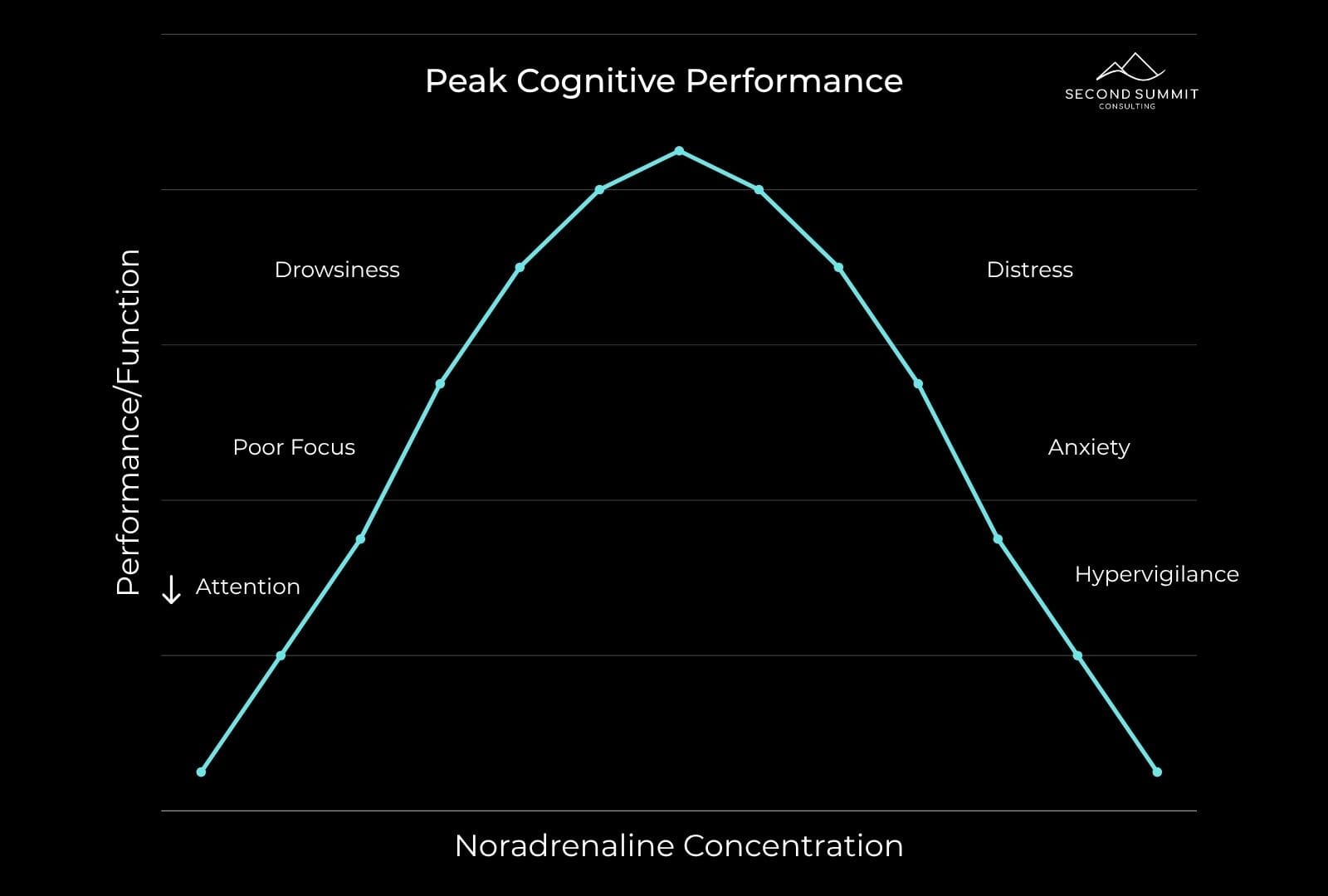
Like dopamine, noradrenaline acts in an 'Inverted-U' concentration mechanism where too little results in drowsiness, inattention, and sluggishness while too much goes the other way to hypervigilance and anxiety.
For peak performance you want to be at the tip of that Inverted-U.
The 3 A's: Arousal, Attention, & Alertness
Noradrenaline is amazingly powerful for producing deep, sustained focus. It can modulate this to be focused on a small, narrow task or be wide, scanning attention looking for threats.
Based on the situation, it will help filter sensory information, removing some and magnifying others based on the desired outcome (making a tool versus watching for a lurking lion). This is called increasing the signal-to-noise ratio of cortical processing. Your senses are collecting an unfathomable amount of data at any one time.
Research out of Caltech has found that your sensory system collects around 1 billion bits of information per second and your conscious brain can really only process 10 bits, that means systems like the LC-NA system has to select the 0.000001% of information that is important and discard the rest, an important job when survival is on the line. As a comparison, modern WiFi connections process around 50 million bits per second.
Noradrenaline works to maintain sustained focus for periods of time and acts in conjunction with dopamine to facilitate executive functioning and cognitive performance.
Due to noradrenaline's critical role in attention, many medications for ADHD primarily work through altering the reuptake of noradrenaline (and dopamine) from the synapse. For a broader review of the neurobiology of attention see this recent open-access review.
Memory Consolidation
As mentioned above, noradrenaline helps modulate memory consolidation of what the brain considers important events while under stress.
From an evolutionary perspective this makes absolute sense. You're running away from a tiger. You spot a rock you might be able to climb atop and escape, you manage to climb it leaving the frustrated tiger at the bottom. Your brain is going to want to remember exactly where that rock was, where each foot hold was so you can escape quickly in future. Therefore, those memories are encoded as strong memories.
As you might imagine, this mechanism has strong implications for post-traumatic stress disorder.
Decision-Making Under Pressure
Before we talk about noradrenaline's sophisticated role in decision-making, first we need to talk about the balance mechanism that occurs in the brain when making decisions called the exploration-exploitation trade-off.
During evolution, our desert wandering ancestors may have found themselves in a position where they could A) spend the day foraging from that same bush of berries they saw yesterday (exploit) or B) spend the day exploring for new bushes to forage from (explore). This may be a simple example but our brains calculate this trade-off for almost all decisions we make, consciously or unconsciously. Not to be confused with a similar but different see-saw called the approach-avoid conflict.
Now, it turns out that the 2 kids on either side of the explore-exploit see-saw are noradrenaline and dopamine where research suggests dopamine primarily drives exploitation (pursuing known rewards) while noradrenaline primarily facilitates exploration (seeking new options).
While deciding whether to get lunch from the usual sushi joint or try that new food truck may not be the peak performance we are after, this balance is incredibly important for high-stakes decision-making where a low noradrenaline to dopamine ratio would cause you to not seek new options to the problem or question. Conversely, a high noradrenaline to dopamine ratio could cause you to spend an excessive amount of time looking for and evaluating new options.
Stress & Adaptation
Much like our friend cortisol (for a primer on cortisol check out this edition of my newsletter), noradrenaline is deeply involved in our stress and adaptation response. And also like cortisol it is central to both our acute and chronic stress response.
Acute activation of the stress response results in:
- LC-NA activation and mobilisation
- Increased attention and cognitive performance
- Increased sensory processing
- Improved memory consolidation for emotionally relevant events
While chronic activation results in:
- Development of anxiety and depression by pushing into the right-hand side of the Inverted-U curve
- Dysregulation of the hypothalamic-pituitary-adrenal system (of which noradrenaline is a part) turns the adaptive stress response into a pathological stress response
- Noradrenaline can interplay with serotonin over time to cause neurobiological normalisation of the pathophysiological anxious depression state
- Some evidence shows it can contribute to the production of gastric ulcers
As with cortisol, we see that managing noradrenaline release in healthy, acute ways optimises peak performance but left uncontrolled not only kills performance but can lead to mental health issues such as anxiety and depression.
Social Processing
It makes sense that, if the LC-NA system helps us to be attuned to the world around us, that this would also include the actions of other people. As expected, research has found noradrenaline to:
- Modulate implicit bias
- Affect moral judgements
- Influence social harm aversion
These effects also appear to change depending on whether the response is acute or chronic.
Interplay with Dopamine
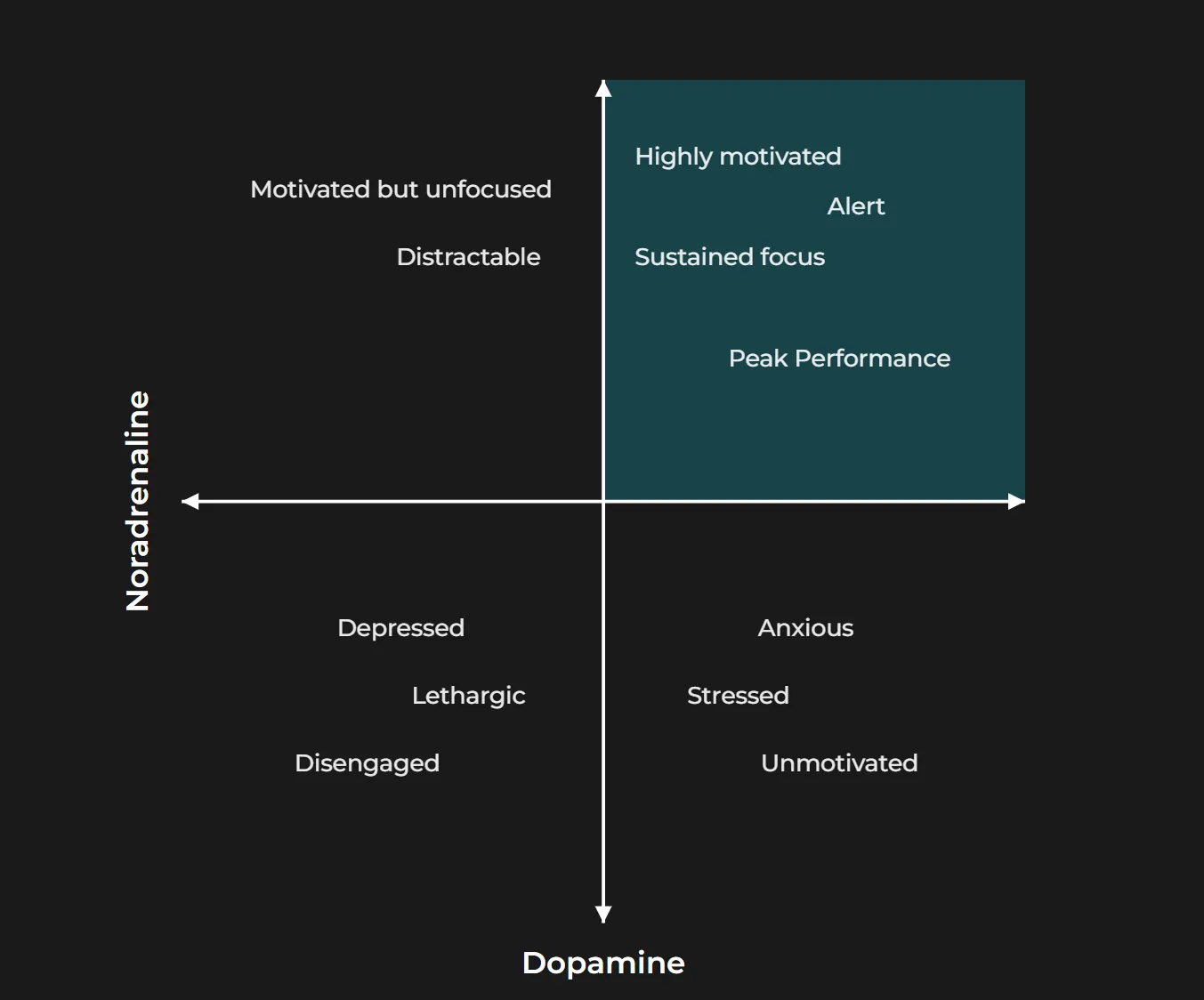
Given that noradrenaline and dopamine are both catecholamines, synthesised from the same raw ingredients, and present in a lot of the same regions, it is not surprising these two tango a lot. The interaction can be (grossly) simplified in the following arousal-motivation matrix where:
- High NE + High DA: Highly motivated, alert, focused (peak performance)
- High NE + Low DA: Anxious, stressed, unmotivated
- Low NE + High DA: Motivated but unfocused, distractible
- Low NE + Low DA: Depressed, lethargic, disengaged
In reality, there are several more players in the game here including acetylcholine.
And now what you've been waiting for …
A Practical Guide to Noradrenaline Optimisation for Peak Performance
To ensure you're in the optimal spot on the Inverted-U there are three areas we need to cover: making noradrenaline, using noradrenaline, and clearing or breaking down noradrenaline.
Making Noradrenaline
Given that noradrenaline is made from dopamine, anything that supports dopamine production also supports noradrenaline production so please see the edition from last week for critical nutritional inputs. The one addition to add is vitamin C which is required for the conversion of dopamine to noradrenaline.
Using Noradrenaline
The Yerkes-Dodson law of the Inverted-U helps us understand healthy engagement with noradrenaline, but here are some (probably all too familiar by now) do’s and don'ts.
Exercise
Exercise itself induces the release of noradrenaline while also supporting long-term regulation. The perfect duo.
Acute effects:
- Intensity-dependent noradrenaline increase
- Moderate exercise produces optimal elevation
- Excessive intensity can over-activate the system
Chronic adaptations:
- Training reduces resting noradrenaline levels (more efficient system)
- Better noradrenergic response to acute demands
- Improved stress resilience
Exercise is beneficial for almost every aspect of peak performance so no matter whether it is a quick 10-min bodyweight session at home if you have time or a 90-min weights session at the gym, something is better than nothing.
Sleep
Important research in Cell earlier this year showed that noradrenaline oscillations during NREM sleep directly regulate the glymphatic system (the brain’s way of removing waste and toxins). Here is how it works.
- During wakefulness: High noradrenaline keeps brain in alert state, glymphatic system mostly inactive
- During sleep: Noradrenaline levels drop, extracellular space expands by 60%, allowing waste clearance
- Breakthrough finding: Slow, synchronised noradrenaline oscillations during NREM sleep predict glymphatic clearance efficiency
Why does this matter?
- Poor sleep → elevated noradrenaline → impaired glymphatic clearance → accumulation of metabolic waste
- Chronic sleep disruption prevents noradrenaline oscillations that drive brain cleaning
- This links to both cognitive decline and increased Alzheimer's risk
Another interesting finding of this work is that some sleep aids (zolpidem) actually aided sleep but impaired this critical process which has important implications for those who use sleep aids.
Once again, prioritise enough, high-quality sleep for this to occur regularly.
Meditation
Meditation produces measurable changes in the LC-NA system. Here is what the science says:
- Meditation decreases catecholamine metabolites
- Long-term practice improves noradrenaline regulation
- Enhances LC-anterior cingulate connectivity
Meditation trains the LC-NA to modulate arousal appropriately, prevent excessive stress responses, and maintain focus without hypervigilance.
Stress Management
As we saw above, chronically high levels of noradrenaline are not good for peak performance or mental health in general. Noradrenaline is released during our stress response so getting our stress levels under control is paramount. This can be done in a few different ways:
- High-quality active recovery between stressors (prevents chronic activation and builds long-term adaptation, for a primer on this see this edition). This includes yoga, meditation, nature exposure, sauna, breathwork, etc.
- Plan small acute stress sessions and embrace them. Research has found that embracing the feelings of stress can promote peak performance but only in acute levels (feeling nervous before giving a talk for example). What does this look like for a big project? Break the next big task/milestone into smaller chunks, create a focus session (90-120 minutes) to complete the task, gear up for it and treat it like a running race and dive in. This pulls a number of different flow triggers.
Cold Exposure
Cold exposure is a form of stress inoculation and represents a form of controlled noradrenaline release. Here's the low down:
The response:
- Cold water immersion: 200-530% increase in noradrenaline
- Sustained elevation lasting hours
- Repeated exposure trains stress system regulation
Why this works:
- Controlled, predictable stressor
- Trains LC-NA system resilience
- Acute arousal boost without anxiety
- Improved stress discrimination (real threats vs. discomfort)
Practical implementation:
- Morning cold exposure for sustained alertness
- Builds mental resilience
- Try small at first <1min and build to 5min preferably <10 Celsius but at least <15 Celsius 3-5x a week
Cleaning Noradrenaline
We have already seen that two activities that promote healthy regulation of noradrenaline also promote its clearance: sleep and meditation. As I have said multiple times, sleep is the ultimate performance hack.
Summary
Like dopamine, noradrenaline exhibits an Inverted-U response meaning a simple 'more' or 'less' protocol won’t suffice. Instead we need to support healthy patterns and usage. To train this system for peak performance we need to train for dynamic range rather than absolutes. That means achieving high levels when needed and having low basal levels when not needed, this is done through five primary mechanisms:
- Healthy dopamine levels (noradrenaline is made from dopamine, remember)
- High-quality sleep to promote natural cycles of noradrenaline and clearance of metabolites
- Meditation for controlled release, top-down arousal control, and additional clearance of noradrenaline metabolites (this is one of the reasons downregulating meditation and breathwork are so important after intense exercise)
- High-quality active recovery (yoga, breathwork, meditation, sauna, etc) between small, highly focused stressor periods
- Stress inoculation like cold exposure to help raise the upper limit of stress perception (brain recodes what high stress is from a Teams meeting to submerging in 4-degree water, which means the Teams meeting now generates lower stress response)
Well done on making it this far, if you did you have noradrenaline and dopamine to thank!
Top 3 Takeaways
- Noradrenaline operates on an Inverted-U curve where peak performance lives at the apex. Too little leaves you drowsy and unfocused, while too much drives hypervigilance and anxiety. Your goal isn't simply more or less noradrenaline but rather hitting the sweet spot where you're alert and focused without tipping into stress, just like we saw with Dopamine last week.
- Train for dynamic range, not static levels. Elite performance requires the ability to spike noradrenaline high when needed (deep focus, critical decisions) and return to low baseline levels during recovery. This is achieved through strategic stress inoculation (such ascold exposure), quality sleep for natural noradrenaline oscillations, and active recovery practices between focused work sessions.
- Noradrenaline and dopamine work as a team, and you can't optimise one without the other. Since noradrenaline is literally made from dopamine, deficiencies in dopamine production cascade into noradrenaline problems. The sweet spot for peak performance is high noradrenaline plus high dopamine, creating that state of motivated, alert, and focused execution we're all chasing.
PS. I have created a new iteration of my 100-day Second Summit Ascent program and am seeking a small cohort of 5 peak performers to road test it, as of writing 4 spots remain. Interested? Let's set up a call to chat and see if it's a good fit for you. Early-adopters will enjoy a heavy discount for helping me build the ultimate 100-day transformation for leaders.