
Breaking Through Inattentional Selection

Firstly, I have skipped a week of publishing as we were moving between islands. I have now settled in the beautiful area of Lake Hāwea.
The Demonstration That Changed Psychology
Before we dive in, watch this classic demonstration. See if you can keep count how many times the players in white pass the basketball:
If you missed something obvious, you're in excellent company. This experiment, conducted by Daniel Simons and Christopher Chabris in 1999, has been cited over 4,700 times and fundamentally changed how we understand attention.
The Science: Your Brain's Invisible Bouncer
What's Actually Happening
Inattentional blindness occurs when you fail to notice a fully visible stimulus because your attention is engaged elsewhere. It's not a bug, this is actually it's a feature. Your brain processes roughly 11 million bits of information per second but can only consciously attend to about 40 bits. This massive filtering operation happens primarily in your prefrontal cortex, which acts like a cognitive bouncer, deciding what gets into the VIP lounge of your consciousness. We covered this in the Attention as Capital edition of the Peak Performance Edge.
The Neural Mechanisms
Recent neuroimaging studies reveal that inattentional blindness involves specific brain networks. When you're focused on a primary task, your brain's attention networks become highly selective, essentially creating "attentional tunnels." The more cognitively demanding your primary task, the narrower these tunnels become.
Individual Differences Matter
Not everyone experiences inattentional blindness equally. Research shows that factors like working memory capacity, cognitive flexibility, and even personality traits influence your susceptibility. Interestingly, expertise doesn't protect you... radiologists miss obvious anomalies, experienced drivers fail to see motorcycles, noone is immune.
The Business Impact: When Blind Spots Cost Millions
Strategic Tunnel Vision
In business, inattentional blindness manifests as what researchers call "organisational inattentional blindness" . Leaders become so focused on quarterly targets that they miss emerging market shifts. Teams concentrating on feature development overlook user experience degradation. The gorilla effect in leadership causes executives to miss critical organisational issues whilst pursuing specific objectives.
Workplace Safety and Performance
Construction industry research shows that workers focused on primary tasks often miss dynamic safety hazards. In healthcare, inattentional blindness contributes to medical errors when clinicians become absorbed in procedures.
The Multitasking Myth
Your brain's filtering system becomes even more restrictive under intense cognitive workload. The deeper your concentration on one task, the less likely you are to notice peripheral information. This includes opportunities, threats, and feedback signals. We also covered this a little in the Attention as Capital edition.
How to Limit Your Blindness: 5 Protocols to Train Your Attention Networks
1. Mindfulness-Based Awareness Training
Research demonstrates that brief mindfulness interventions significantly reduce inattentional blindness. Practice this daily:
- Open Monitoring Meditation (10 minutes): Sit comfortably and observe whatever enters your awareness without focusing on any particular object. Notice sounds, sensations, thoughts, and emotions as they arise and pass.
- Peripheral Vision Exercises: While reading or working, periodically expand your visual attention to include your entire visual field. Practice noticing movement and changes in your periphery.
2. Attention Training Technique (ATT)
Developed by Adrian Wells, ATT strengthens executive control over attention allocation:
- Selective Attention Phase: Focus on one specific sound (e.g., traffic) whilst other sounds are present
- Divided Attention Phase: Simultaneously attend to multiple sounds
- Attention Switching Phase: Rapidly shift focus between different auditory stimuli
Practice 15 minutes daily for optimal results.
3. Cognitive Flexibility Training
Game-based training that requires frequent task-switching improves your ability to notice unexpected stimuli:
- Task-Switching Protocols: Alternate between different cognitive tasks every 2-3 minutes
- Dual N-Back Training: Simultaneously track visual and auditory sequences
- Stroop Task Variations: Practice inhibiting automatic responses whilst maintaining awareness
4. Environmental Design Strategies
Organisational interventions can reduce inattentional blindness:
- Structured Breaks: Implement 5-minute attention resets every 45 minutes. Even 40 seconds looking at a green roof can help
- Devil's Advocate Protocols: Assign team members to actively look for what others might miss
- Perspective Rotation: Regularly switch roles or viewpoints during planning sessions
- Environmental Scanning: Schedule weekly "peripheral vision" reviews to identify overlooked opportunities or threats
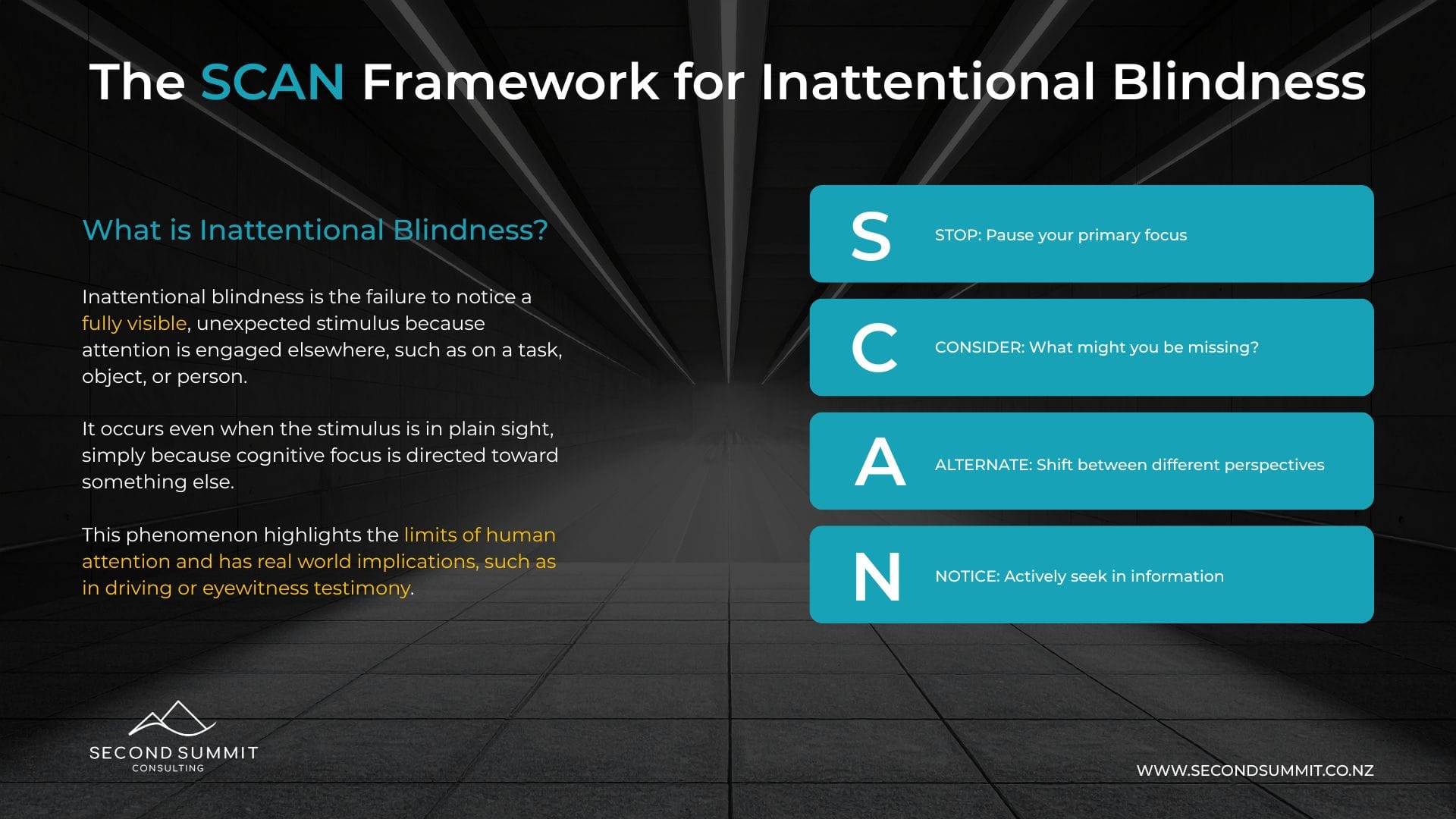
5. The SCAN Framework
For high-stakes decisions, use this systematic approach:
- Stop: Pause your primary focus
- Consider: What might you be missing?
- Alternate: Shift to a different perspective
- Notice: Actively scan for unexpected information
Expected Outcomes
With consistent practice, expect to see improvements within 2-4 weeks. You'll notice enhanced situational awareness, better decision-making under pressure, and increased ability to spot opportunities others miss. Remember: your brain's filtering system evolved to keep you alive, not to move your business forward. Training it for modern performance demands requires deliberate practice.
The gorilla is always there. The question is: will you see it?