Breathe Your Way to Peak Performance: The Neuroscience of How Your Breath Shapes Your Brain, Body, and Success

TL;DR
Your breath is the most accessible tool you have for regulating your nervous system, enhancing cognitive performance, and optimising physical output. Evidence shows that specific breathing practices can reduce stress, improve focus, enhance athletic performance, and increase resilience. This article breaks down the neuroscience and provides actionable protocols you can implement immediately. Scroll down to 'Actionable Protocols' below for five outcome-specific science-based protocols.
Why Your Breath Matters More Than You Think
You take roughly 20,000 breaths per day. It’s the one constant from birth to death. Most happen on autopilot, but here's what the data shows: deliberately controlling your breathing pattern is one of the fastest ways to shift your physiological state and cognitive function.
Unlike most performance interventions that require equipment, apps, or external resources, your breath is always available, from birth to death, always. It is literally a bridge between your conscious mind and autonomic nervous system. Master it, and you gain direct control over typically unconscious states such as stress responses, mental clarity, and physical capacity.
The research base has exploded recently, with meta-analyses demonstrating meaningful effects on stress, anxiety, mood, and cognitive performance (for a few studies see here, here, and here). But breathwork isn't just relaxation. Done strategically, it can actually prime your nervous system for high-performance states or facilitate rapid recovery.
The Neural Mechanics: How Breathing Rewires Your Brain
The Vagus Nerve Connection
Your diaphragm is a large muscle underneath your lungs that expands and contracts to draw in and expel air when you breathe, but it does more than move air. When you breathe deeply from your abdomen (a lot of us don’t do this at rest unless we train ourselves to, I had to), you mechanically stimulate the vagus nerve, the primary pathway of your parasympathetic nervous system. This triggers a cascade of physiological changes:
- Lowered heart rate and blood pressure (study from Huberman’s group in Cell Reports Medicine here and a systematic review here)
- Reduced cortisol and other stress hormones (direct measurement of cortisol study here)
- Increased heart rate variability (HRV), a marker of nervous system flexibility (reviewed here)
Think of HRV as your system's ability to shift gears smoothly. Higher HRV correlates with better stress resilience, emotional regulation, and cognitive performance (if you’re not tracking this metric with something like a Whoop, start now!). Controlled breathing directly modulates this metric.
If you want to double down on your vagus conditioning and stimulation (which I suggest you do), OM meditation is a great option. The OM chanting in OM meditation has been scientifically shown to stimulate the vagus nerve enhancing parasympathetic nervous activity, promoting relaxation, and calmness. And the effects are immediate.
Brain Wave Alterations
The effects reach beyond the autonomic nervous system. EEG studies show that slow breathing techniques increase alpha wave activity (associated with calm alertness) while decreasing theta waves (linked to drowsiness), see this fantastic review for more. Essentially, you're tuning your brain to an optimal frequency for focused work without the mental fog or hyperarousal that tanks performance. Coincidentally, the brain shifts towards alpha-theta (away from beta) when in flow state which may explain why breathwork is an excellent facilitator of the flow state.
Rapid Communication Pathways
Given the importance of breath for survival, the connection between your respiratory system and your brain is tight. Modified breathing patterns alter signals sent from your respiratory system to brain regions regulating behaviour, thought, and emotion (and this can happen within minutes). This communication is bidirectional and immediate. Change your breath, and you change your brain state within minutes, not weeks.
Mental Performance: The Cognitive Edge
Stress Reduction and Anxiety Management
The evidence here is robust. A 2023 meta-analysis examining multiple studies found that breathwork interventions significantly reduced self-reported stress compared to control conditions. Effect sizes ranged from small to medium, but critically, these were achieved with minimal time investment.
One randomised controlled trial compared daily 5-minute breathing exercises against mindfulness meditation over one month. The breathing conditions (particularly cyclic sighing, which emphasises prolonged exhalations) produced greater improvements in mood and reduced respiratory rate more effectively than meditation.
Why does this matter? Because stress isn't just uncomfortable. As we saw in my newsletter edition on cortisol, it degrades working memory, narrows attentional focus, and impairs decision-making. Every high-stakes decision you make under chronic stress is cognitively compromised.
Enhanced Focus and Cognitive Performance
Diaphragmatic breathing has been shown to improve attention, reduce negative affect, and enhance cognitive performance in healthy adults. The mechanism appears to involve several aspects:
- Increased oxygen delivery to the brain may support neuroplasticity
- Reduced physiological stress markers free up cognitive resources
- Improved emotional regulation prevents cognitive hijacking
Studies show that regular breathing exercises can improve attention span and memory retention.
The Caveat
Not all breathwork is created equal. A 2023 systematic review found that effective practices avoided fast-only breathing paces and sessions shorter than 5 minutes, while including human-guided training and long-term practice yielded better outcomes. This is where finding a breathwork coach can yield huge gains.
Physical Performance: Beyond the Mind
Athletic Applications
Controlled, rhythmic breathing improves focus and concentration during athletic performance. Elite athletes, including NBA players, use deep breathing to calm their minds and reach peak states. The mechanisms include:
- Optimised oxygen use and CO₂ tolerance
- Balanced autonomic nervous system activation
- Enhanced muscular recovery post-workout
For endurance activities like trail running or mountain biking, breathwork can increase performance capacity by improving ventilation efficiency and maintaining ideal blood gas ratios (this review is specifically looking at breathwork to enhance running). This supports better neuronal activity and sustained mental performance during physical exertion.
The Autonomic Balance
Many athletes (and indeed non-athletes) habitually overbreathe, pushing them into sympathetic dominance. While acute stress arousal has its place in sprints, chronic fight-or-flight activation degrades performance over time. Strategic breathwork teaches your system to shift efficiently between arousal states.
A fantastic primer on this topic is “Breath: The New Science of a Lost Art” by James Nestor which not only runs through the mechanics but also looks at the reasons why the modern human breathes in a non-optimal way. Highly recommend this read.
Actionable Protocols: What the Evidence Supports
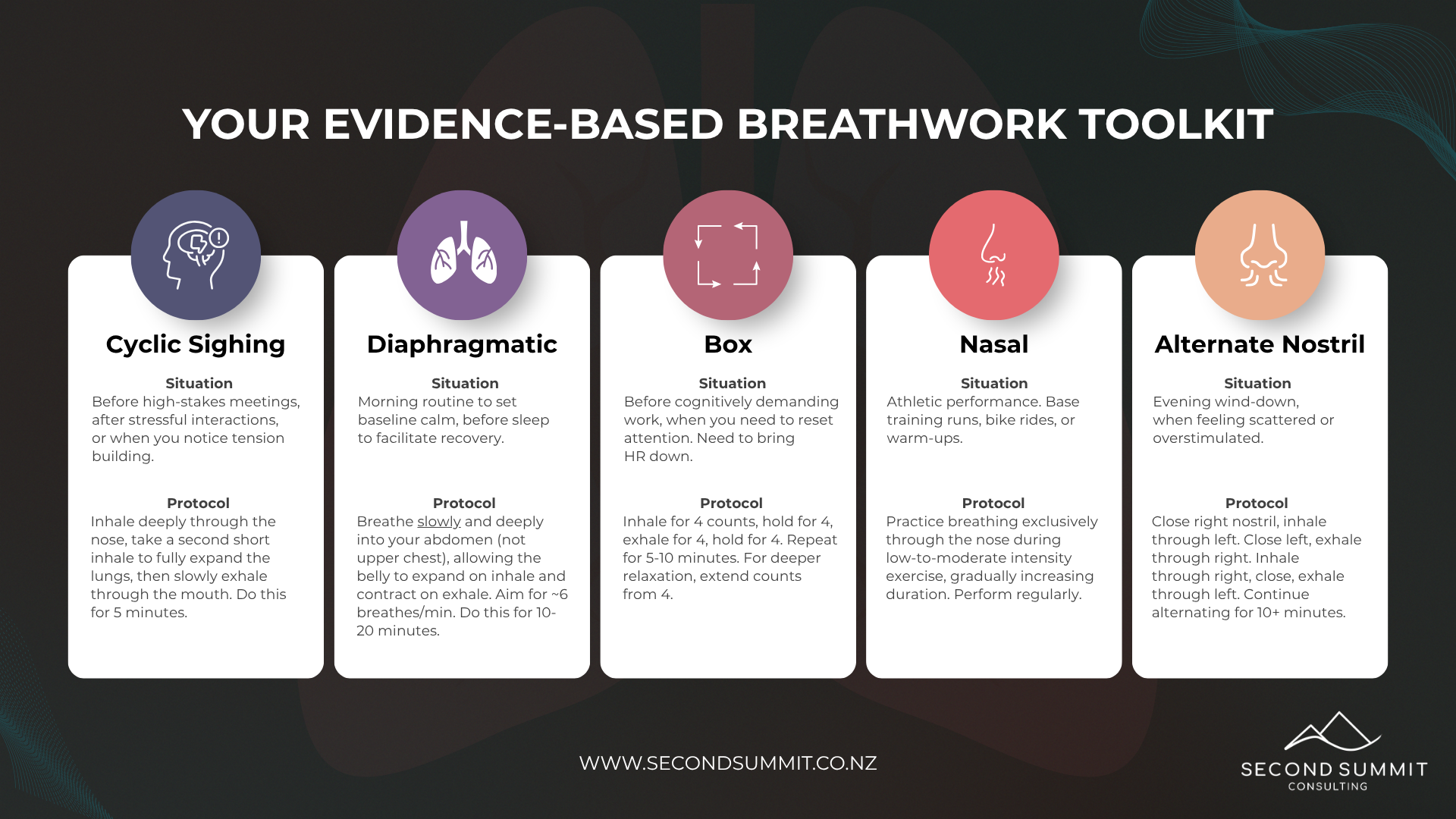
For Immediate Stress Reduction: Cyclic Sighing (AKA the physiological sigh)
Protocol: Inhale deeply through the nose, take a second short inhale to fully expand the lungs, then slowly exhale through the mouth. This is the protocol from this recent study.
Duration: 5 minutes
Evidence: Produced greater mood improvement than meditation in controlled trials
Use case: Before high-stakes meetings, after stressful interactions, or when you notice tension building and need a quick reset
For Sustained Calm: Diaphragmatic Breathing
Protocol: Breathe slowly and deeply into your abdomen (not upper chest), allowing the belly to expand on inhale and contract on exhale. Aim for 6-10 breaths per minute. Pro tip: use an app like Next Step Collective to find amazing protocols for this along with quality guidance and music (along with many other awesome guided breathwork sessions. No affiliation, just love the app and use it daily).
Duration: 10-20 minutes
Evidence: Reduces physiological and psychological stress markers, improves HRV
Use case: Morning routine to set baseline calm, before sleep to facilitate recovery
For Enhanced Focus: Box Breathing
Protocol: Inhale for 4 counts, hold for 4, exhale for 4, hold for 4. Repeat.
Duration: 5-10 minutes
Evidence: Used by military personnel and elite performers; anecdotal reports strong, formal studies limited
Use case: Before cognitively demanding work, when you need to reset attention
For Athletic Performance: Nasal Breathing Training
Protocol: Practice breathing exclusively through the nose during low-to-moderate intensity exercise, gradually increasing duration.
Duration: Progressive over weeks
Evidence: Improves CO₂ tolerance and respiratory efficiency (see this review for more)
Use case: Base training runs, bike rides, or warm-ups
For Nervous System Training: Alternate Nostril Breathing
Protocol: Close right nostril, inhale through left. Close left, exhale through right. Inhale through right, close, exhale through left. Continue alternating.
Duration: 5-10 minutes
Evidence: Studies show stress reduction with 30 minutes daily practice. This is ancient yogic breath practice.
Use case: Evening wind-down, when feeling scattered or overstimulated
Implementation Strategy
Start Small, Build Consistency
The data consistently shows that benefits accrue with regular practice, not heroic one-off sessions. Find a breathwork protocol that ticks the boxes for you. Lock it to an existing habit: after your morning coffee, before lunch, or as part of your pre-bed routine.
Use Your Breath as Biofeedback
Notice how different breathing patterns affect your state. Fast, shallow breathing signals threat to your nervous system, regardless of actual danger. Slow, deep breathing communicates safety. While being a tool control your mental state, it’s also an excellent readout of it.
Track Your Markers
To quote from management literature: “what is not measured, cannot be improved; what is not improved, is always degraded.” Monitor subjective stress, sleep quality, and cognitive performance. If you have an HRV tracker, watch how your baseline shifts over weeks. A word of caution: the data should inform your practice, not replace your subjective experience.
What to Expect (Realistic Timeline)
Days 1-7: Increased awareness of breathing patterns, potential initial awkwardness as you override autopilot
Weeks 2-4: Noticeable reduction in stress reactivity, easier access to calm states
Months 2-3: Enhanced baseline HRV, improved cognitive performance under pressure, better recovery metrics
Breathwork offers both acute and long-term benefits. You're retraining neural pathways shaped by decades of habitual patterns. Be patient with the process and reap both benefits.
The Bottom Line
Your breath is the most underutilised performance tool you have access to. The neuroscience is clear: controlled breathing practices directly modulate your nervous system, enhance cognitive function, reduce stress, and improve physical performance.
You don't need an app, a subscription, or a guru. You need 5-10 minutes daily and the willingness to practice deliberately. Start with diaphragmatic breathing. Master that foundation. Then layer in protocols matched to your specific performance goals.
My challenge to you:
- Choose one protocol from above
- Practice it daily for two weeks
- Track your subjective stress and performance
- Adjust based on your response
- Email me your results at simon@secondsummit.co.nz
PS. I have created a new iteration of my 100-day Second Summit Ascent program and am seeking a small cohort of 5 peak performers to road test it, as of writing 3 spots remain. Interested? Let's set up a call to chat and see if it's a good fit for you. Early-adopters will enjoy a discount for helping me build the ultimate 100-day transformation for leaders.