
Cortisol: The Jekyll and Hyde of Peak Performance

Think cortisol and most people think stress. For years stress management approaches have taught us to ‘lower our cortisol’ but cortisol is one of the strongest peak performance tools we have. The trick? Getting on top of its biology. In this article I break down the fundamentals of cortisol and how the modern workplace creates a biological ceiling and I provide 5 evidence-based protocols for how to break that ceiling.
The Biology Basics
When you encounter a stressor, be it physical, psychological, or environmental, a small, primitive area in your brain called the hypothalamus releases a hormone call corticotrophin releasing hormone, or CRH for short. CRH then signals to your pituitary gland (a small pea sized organ located directly below the hypothalamus in your brain) to release adrenocorticotropic hormone (ACTH) which ultimately prompts your adrenal gland to release cortisol into your blood stream. This happens over the course of a matter of seconds and cortisol levels continue to rise and peak at around 30 minutes.
Once in the bloodstream, cortisol reacts with glucocorticoid receptors all throughout your body in prepare it to deal with the stress you just faced. It mobilises energy for your muscles, it enhances your cardiovascular system function, it temporarily suppresses ‘non-essential’ activity (such as digestion) in order to focus resources where they are needed. Cortisol boosts alertness and attention. All of this prioritises immediate survival.
Evolutionarily speaking, coming across a lion and suddenly having unlimited energy, heart into overdrive, and all energy needs focused on survival was a very good thing. Once the stressor has been avoided, cortisol is mostly cleared by your liver returning to baseline levels within an hour or so. Normal metabolism resumes. BAU.
The Cortisol Awakening Response (CAR)
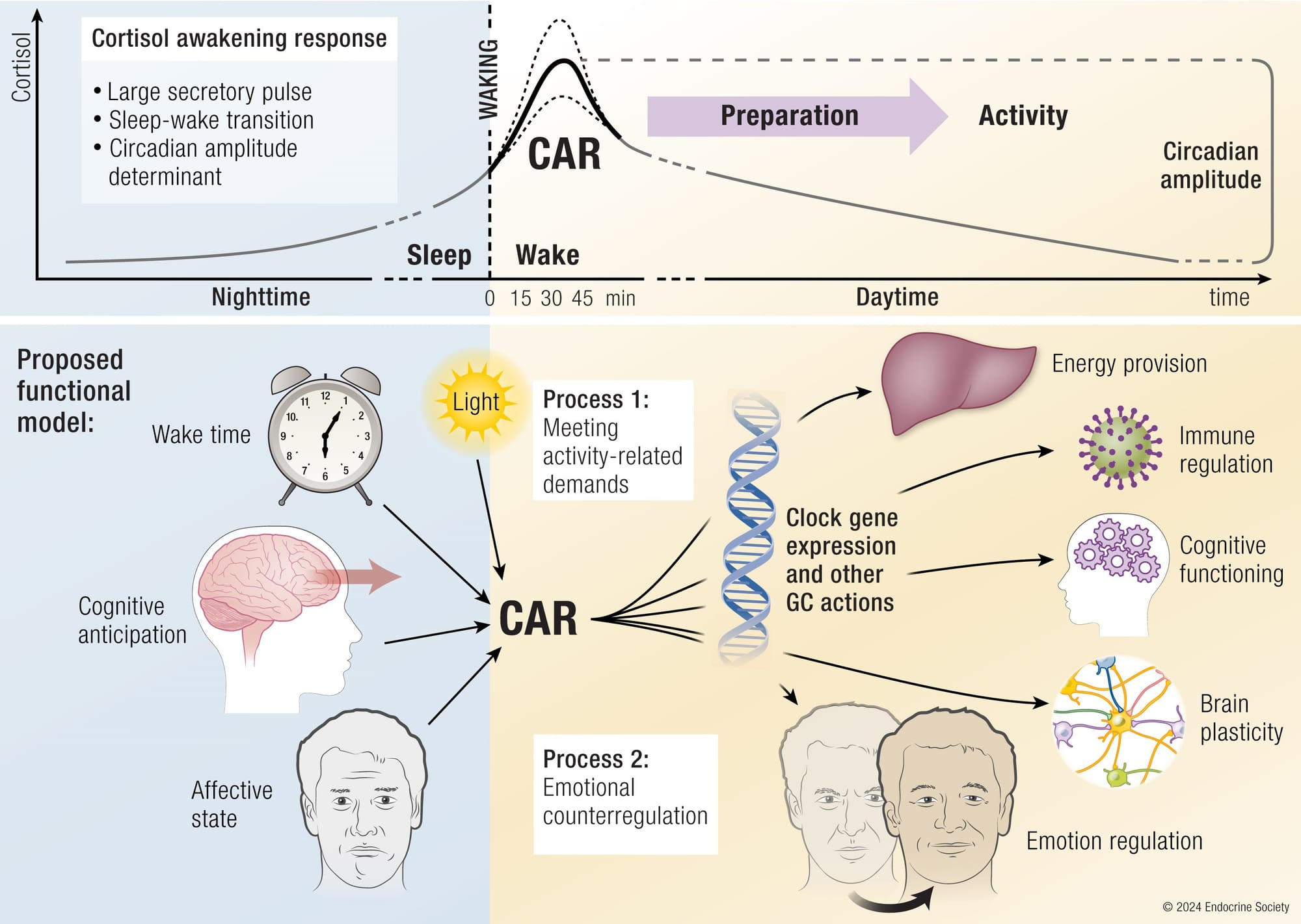
In addition to the acute, survival targeted, response above, cortisol levels in your blood increase and decrease in a cyclical fashion to facilitate activity during the day and sleep at night. In healthy individuals, there is a sharp spike 30-45 minutes after waking, which then declines throughout the day, being lowest at midnight. The CAR draws upon key circadian, environmental, and neurocognitive processes to predict the daily need for cortisol-related action. The below figure from a review earlier this year summarises the CAR nicely.
The Neuroscience: Cortisol & Your Brain
It should be no surprise that, in addition to preparing your body for battle, cortisol also has strong activity in your brain. Cortisol receptors are highly concentrated in the prefrontal cortex (the area of the brain responsible for a lot of higher cognitive functions such as future planning and strategic thinking), the hippocampus (memory), and the amygdala (emotional processing area of the brain).
The Hippocampus: Memory's Double-Edged Response
In healthy individuals, the effects of cortisol in the brain are what we call biphasic (doing 2 different things over time). In the immediate phase (15-30 minutes) there is a mild impairment in working memory and in the delayed phase (60-90 minutes) there is enhanced consolidation and retrieval. This is an evolutionary mechanism to improve ‘burn in’ of emotional memories. From a survival perspective, encoding survival related memories accurately matters more than recalling working memory, so this trade-off makes sense for survival (it’s also why scary and stressful memories can be in excruciating detail and persist for a long time).
The Amygdala: Emotional Hypervigilance
During high cortisol exposure, your amygdala is dramatically sensitised creating a state of emotional hypervigilance. This heightened reactivity dials up threat detection and emotional processing, allowing quick identification of potential dangers in your environment. Whilst beneficial for survival, this amplification comes at the cost of unselective attention and increased distraction by emotionally irrelevant information.
The Prefrontal Cortex (PFC): Executive Function Under Siege
One of cortisol's most pronounced effects is on the PFC. The PFC is the brain region responsible for executive control, rational decision-making, and top-down regulation. With cortisol in the system, the prefrontal cortex essentially gets "taken offline" to allow more primitive, reflexive brain systems to dominate behaviour. Representing a functional shift from deliberate, analytical thinking towards faster, more automatic responses.
The effect of acute cortisol essentially shifts the brain from analytical to emotional, from calculated to reflexive. All of which are very useful when outrunning a lion, but can become a burden when they remain active for extended periods of time.
Too Much of a Good Thing: The Effects of Chronically Elevated Cortisol
While it might feel like we live very comfortable lives, modern humans have a lot more cortisol kicking around their bloodstreams compared to our savannah-dwelling ancestors. This is largely due to 2 reasons. Firstly, because we are not running away from lions or getting besieged by a rival tribe on a regular basis our stress system has forgotten what it was built for and now reacts to much more trivial stressors (hello Teams call). Second, modern stressors tend to be far more chronic in nature (work pressure, financial concerns, social media, what the Kardashians are doing) and therefore the system is no longer fit for purpose.
I don’t need to belabour the point here, we’ve all heard it a lot, chronically elevated cortisol is terrible for health and cognition. I wrote a little about this in my recent article ‘Dying to Succeed - The Real Cost of Overwork’.
The good news? Both of the reasons we find ourselves swimming in cortisol in the modern world can be effectively addressed and normalised.
Wrangling Your Cortisol: 5 Evidence-Based Protocols
Protocol 1: Optimise Your Cortisol Awakening Response (CAR)
The Science:
As mentioned above, the CAR is regulated by circadian, environmental, and neurocognitive processes to predict daily cortisol needs. A robust CAR is associated with better cognitive performance, while a blunted or exaggerated CAR indicates dysregulation.
The Protocol:
- Consistent wake time (±30 minutes) 7 days/week
- Light exposure within 5-30 minutes of waking
- 10-15 minutes of bright light (ideally outdoors, 10,000+ lux)
- Consider avoiding screens for first 30 minutes to allow natural CAR development
- Strategic morning caffeine timing
- Delay coffee 90-120 minutes post-waking
- Allows CAR to complete naturally before adding stimulant
- Prevents interference with cortisol's natural rhythm
- Morning anticipation practice
- Upon waking, spend 2-3 minutes mentally previewing day's challenges
- CAR appears to be anticipatory; this primes the system appropriately
- Sets cortisol trajectory to match actual demands
Expected Outcome: Sharper morning focus, reduced afternoon energy crashes, better stress resilience. Allow 2-3 weeks for rhythm establishment.
Protocol 2: Leverage Cortisol's Dual-Phase Effects for High-Stakes Performance
The Science:
Cortisol exerts non-genomic (not related to gene expression) effects within 15-30 minutes and genomic effects (due to gene expression) after 60-90 minutes. The immediate phase increases emotional reactivity, while the delayed phase enhances emotion regulation and cognitive control.
The Protocol:
- Pre-performance timing (for presentations, difficult conversations, high-stakes meetings)
- Schedule 90 minutes before event
- Brief physiological arousal exercise: 20 burpees, cold exposure, or breath holds
- Allows initial reactivity phase to pass before performance
- Captures enhanced regulation phase during actual event
- Post-stress consolidation window
- Within 60-90 minutes after challenging experience, engage in 10-minute structured reflection
- Enhanced consolidation during genomic phase strengthens learning
- Transforms stressful experience into performance data
Expected Outcome: Improved performance during high-pressure situations, better emotional regulation during conflict, enhanced learning from challenging experiences.
Protocol 3: Strategic Stress Inoculation Training
The Science:
Re-educating your stress system. By ‘reminding’ your stress system what high stress actually looks like the HPA axis will re-baseline its stress response. This means the smaller trivial events that triggered the response will now trigger a smaller response or none at all.
The Protocol:
- Weekly deliberate stress exposure (2x per week, non-consecutive days)
- High-intensity interval training: 4-6 rounds of 30 sec max effort, 2 min recovery
- Cold water immersion: 2-4 minutes at 10-15°C or less
- These create controlled cortisol spikes similar to work stress
- Active recovery integration
- Within 30 minutes post-exposure: parasympathetic activation
- 10 minutes box breathing: 4-4-4-4 pattern
- Teaches body the "off switch" for stress response
- Prevents chronic elevation from work stress
- Progressive overload approach
- Week 1-2: 2 rounds HIIT or 2 min cold exposure
- Week 3-4: 4 rounds HIIT or 3 min cold exposure
- Week 5+: 6 rounds HIIT or 4 min cold exposure
- Builds stress resilience capacity over time
Expected Outcome: Greater stress tolerance during work challenges, faster recovery from acute stressors, improved HPA axis regulation. Meta-analysis by Rogerson et al. (2024) shows stress management interventions effectively modify cortisol patterns.
Protocol 4: Evening Cortisol Clearance Routine
The Science:
Elevated evening cortisol disrupts sleep architecture and prevents proper HPA axis reset. Mindfulness and relaxation interventions show strong effects on cortisol regulation, particularly the awakening response.
The Protocol:
- 90-minute pre-sleep wind-down (non-negotiable)
- Progressive muscle relaxation: 10 minutes, systematic tension-release of muscle groups
- Dim lighting (<50 lux) to support melatonin rise (preferably below eye-level)
- Room temperature <20°C
- Cognitive offloading practice
- 10-minute brain dump: write all pending tasks/worries
- Transfers cognitive load from working memory
- Reduces anticipatory cortisol activation
- Keep notebook bedside for intrusive thoughts
- OPTIONAL: Preview tomorrow’s challenges. As above, CAR appears to be anticipatory, prep can fine-tune the response.
- Reverse alarm
- Set countdown timer for 60 minutes before target sleep time
- Signals transition to wind-down protocol
- Creates conditioned response over time
Expected Outcome: Reduced sleep latency, improved sleep quality, healthier CAR the following morning. Research shows evening cortisol levels directly predict next-day CAR.
Protocol 5: Tactical Nutrition for Cortisol Regulation
The Science:
Cortisol drives gluconeogenesis (production of glucose) and influences glucose availability. Blood sugar instability amplifies cortisol secretion, creating a cycle. Specific nutrients support HPA axis regulation.
The Protocol:
- Protein-first breakfast within 60 minutes of waking
- Minimum 30g protein (for 80kg individual)
- Stabilises blood glucose during CAR window
- Prevents reactive hypoglycaemia that triggers additional cortisol release
- Magnesium supplementation
- 400-500mg magnesium glycinate 60 minutes before sleep
- Supports GABA activity, promotes HPA axis recovery
- Deficiency associated with exaggerated stress response
- Adaptogen integration
- Ashwagandha: 300mg twice daily (600mg total)
- Research shows cortisol reduction of 14.5-27.9% over 8 weeks
- Take with meals to reduce GI effects
- Note: Some evidence for other adaptogens, but less robust than these interventions
Expected Outcome: More stable energy throughout day, reduced reactive eating, improved stress resilience. Allow 4-6 weeks for adaptogen effects.
Start with Protocol 1 (CAR optimisation) as foundation for all others. Add one protocol every 2-3 weeks to avoid overwhelming system with simultaneous changes.
Track objective markers:
- Resting heart rate upon waking (↓ indicates improved regulation)
- Heart rate variability (↑ indicates better autonomic balance)
- Subjective energy ratings at 10:00, 14:00, 18:00 (should show consistent pattern)
For additional reading see this recent open-access review and the above mentioned paper on the CAR. Cortisol doesn’t need to be the killer of high performance it is made out to be. Rebuilding your operating system from the ground up to respect your biology can harness cortisol's power without the dark side it is more commonly known for. Your brain isn’t broken - the operating system is.