
Measurable Optimisation: How Data-Driven Performance Engineering Beats Hope-Based Improvement

You've optimised everything at work. Every process. Every metric. Every KPI. So why do you still feel like you're running on empty?
Here's what most executives miss: You measure your business performance obsessively, but you're flying blind when it comes to your cognitive capacity. You wouldn't run a company without knowing your cash position. Why would you run yourself without knowing your mental reserves?
What gets measured gets optimised
Measurement Drives Improvement
Research into a wide range of sectors has consistently found that measurement and tracking of key metrics and parameters is the primary driver of performance improvement. Without measurement, improvement efforts are random and unsustainable and in the era of the modern professional, knowing that your time investment is paying off is critical.
Healthcare is a sector that has received much interest in this area given that performance slumps can result in death as opposed to not meeting Q3 targets. The evidence is compelling: a UK hospital mortality reduction programme using systematic measurement and feedback reduced their standardised mortality ratio from 94.6 to 77.5 over four years, translating to 905 fewer deaths than expected.
Similarly, Mayo Clinic's system-wide mortality reduction project decreased mortality from 1.78 to 1.53 per 100 admissions through measurement-driven care redesign. Multiple studies consistently show that measurement of key KPIs, both in terms of processes and outcomes, drastically improves what matters most - patient outcomes.
Of course this can be overdone where tracking any and all metrics makes them all become equally useless. The key is to identify the end-state reverse engineer the metrics and KPIs that will support that, and set up tracking. Objective measurement creates accountability and enables systematic optimisation.
HRV: Your Real-Time Cognitive Capacity Dashboard
As a case study, let’s look at a common health metric that receives a lot of attention (both good and bad) - heart rate variability (HRV). If you’ve missed it from my previous editions, HRV is simply the variation in time between heart beats. What it represents is the current state of the push-pull between the sympathetic and vagal systems on the heart. This gives an indirect measure of your nervous systems current state. This can be very valuable information.
HRV is used for many things. Clinically it is used in the prediction of sudden cardiac death and assessing cardiovascular and metabolic illness progression. It is also used as an input for predicting performance in athletes.
More recently, much research has emerged showing the utility of HRV in relation to cognitive function. This systematic review of twenty studies with over 19,000 patients concluded that “both increased sympathetic activity and decreased parasympathetic activity seem to be associated with a worse performance in the cognitive domains considered, in the absence of dementia and severe cardiovascular diseases or other medical and psychiatric diseases”. Another meta-analysis found that a higher HRV was associated with better top-down self-regulation and conclude that “HRV indices can tentatively be employed as bio-markers of top-down self-regulation“. Finally, this systematic review found a small positive association between vagally-mediated HRV and executive functioning and went on to find that “vagally-mediated HRV predicts cognitive inhibition and cognitive flexibility more than working memory.”
Interestingly, this systematic review of using HRV biofeedback (training individuals to increase their HRV through breathing techniques) found that HRV biofeedback training was beneficial in increasing attentional skills, inhibition, and working memory with a higher effectiveness in populations exposed to stress. These findings are supported by this systematic review highlighting the potential of physiological interventions to improve psychological outcomes.
Metrics like this are a window into the performance infrastructure under the hood. Knowing there is enough oil in the car doesn’t mean you’re going to win the race, but knowing there isn’t enough means you can avoid blowing up the engine trying. And like oil level is just one of many indicators of your likely race outcome, HRV is just one of many metrics for human performance.
The Quantified Self Advantage
The argument of tracking and improving HRV is powerful but it is just one of many metrics you might consider. The modern era of wearables allows tracking of sleep (time and quality), weight, body fat %, glucose levels, blood pressure, hydration, resting heart rate … the list goes on. Each of these metrics provide a small but important window into the complex system that is the human body. Further, these metrics are objective and are bias-free and much less susceptible to the numerous psychological variables that give rise to subjective assessments.
Research finds that objective measures trump subjective assessment when it comes to real-world performance. This umbrella review (a review of other systematic reviews and meta-analyses typically used in evidence-based healthcare) looking at subjective (self-reported) versus objective (performance-based) cognitive performance found that “subjective and objective cognition do not share a meaningful relationship” and conclude that “Researchers and clinicians should not expect to find concordance between concurrent self-reported cognition and neuropsychological testing, and simple discrepancies between subjective and objective cognition are so common as to be diagnostically unhelpful”.
The research is clear. Tracking physiological metrics can enhance our performance and performance improvement. It turns hopeful benefit into targeted, validated improvement. From crossing fingers to calculable ROI. Knowing the foundation you are working from day-to-day, moment-to-moment can empower you make evidence-base decisions to support high performance, high flow life. I know what you're thinking: 'Great, another thing to track.' But here's the difference: workplace metrics measure output. These metrics measure capacity and progress. One asks 'did you hit your targets?' The other asks 'do you have what you need to perform?' One creates pressure. The other creates awareness.
The (Over)Optimisation Trap
Goodhart's Law states that “When a measure becomes a target it ceases to become a good measure”. This law as originally developed in the context of monetary policy and economics but applies across a wide range of industries. The principle highlights how measures lose their effectiveness once they become targets, as people begin to manipulate behaviour to meet the metric rather than improve the underlying outcome.
We should develop an action plan of behaviours to regulate our autonomic nervous system and use HRV as one of several metrics to assess if our plan is working rather than try and move the needle on HRV alone. We should develop a holistic exercise plan that promotes cardio, strength, and flexibility/mobility and use step count as one of several metrics to assess our plans progress rather than ensuring a circle on our apple watch is filled.
Approach: Research suggests using "a range of measures to regularly monitor health system performance" rather than single targets. For cognitive optimisation:
- Track HRV alongside sleep quality, stress levels, and subjective wellbeing for a full picture
- Use process indicators (breathing protocols, exercise consistency etc) not just outcomes
- Focus on trends over time rather than daily fluctuations
Measurements should be "used to understand, plan, and improve - not as a whip. The goal is using objective data to guide optimisation while avoiding the trap of optimising for the metric itself.
Psychology Follows Physiology
Over the past few editions of the Peak Performance Edge I have attempted to distil the ethos and foundation from which I operate. I have captured my manifesto across three themes:
- Biology As Your Operating System: This is a physiology-first approach that recognises that for truly sustainable and embedded performance gains the foundation needs to be setup for success.
- Intervention Hierarchy: This systematic approach builds the engine from first principles to ensure the foundation is strong and durable. It’s the sharpening of the axe before the chop. The rebuild of the race engine before a big season.
- Measurable Optimisation: Every week there is a new trend. A new hack. A new “here’s what X knows that you don’t”. Some of these work. Others are what worked for one person in that time. Others again serve as nothing more than a time sink. The way to tell the difference for you? Measure. Objectively. You’re busy and want to be pouring your time and energy into things that move the needle. Measurement is the way to ensure you are.
As Steven Kotler says: “Personality doesn’t scale, biology does:”. So let’s start there.
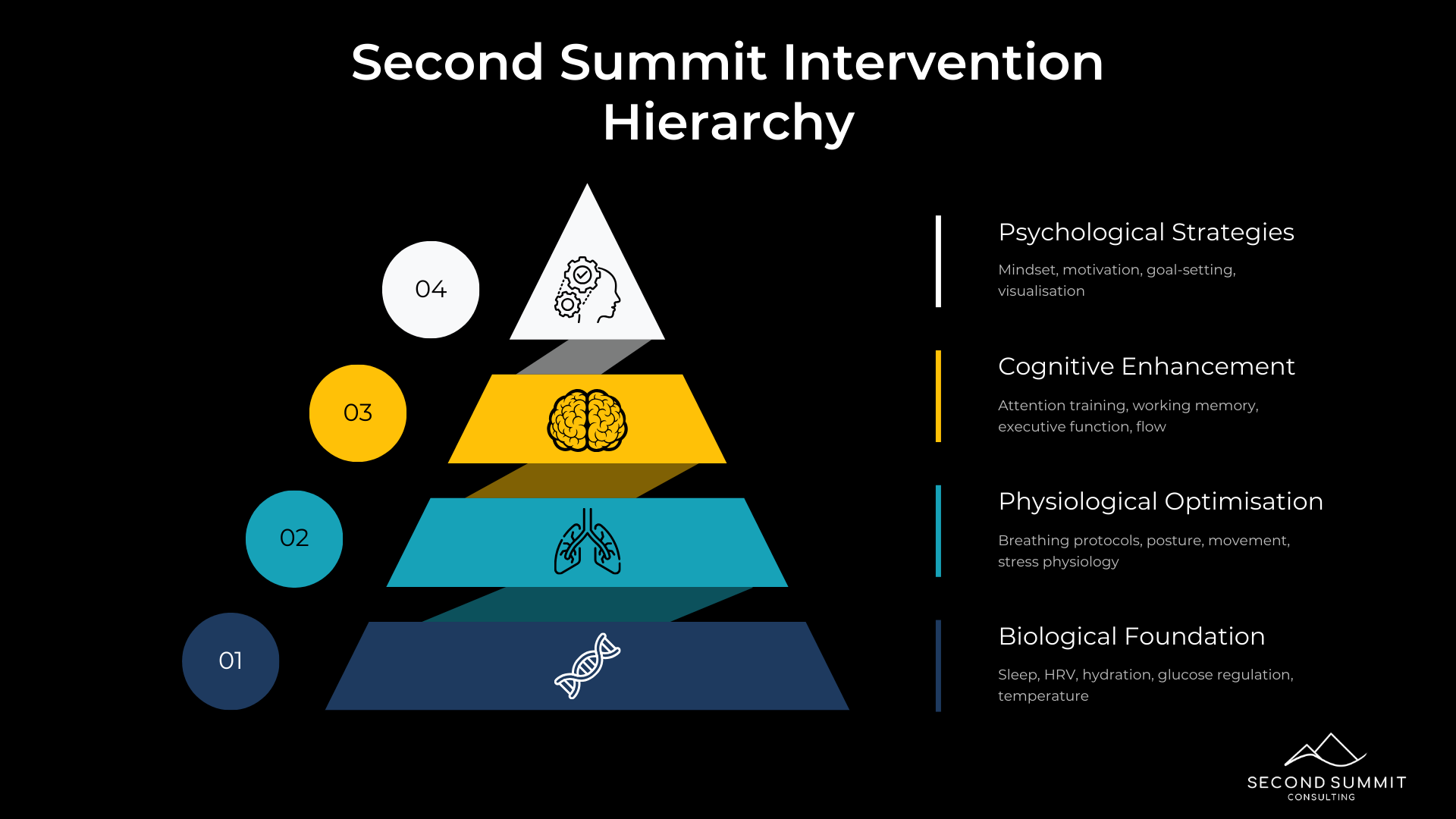
This hierarchy is designed so each layer supports the one above it. The research on intervention effectiveness shows it’s the foundational-level interventions that target the underlying systems that drive sustainable outcomes, whilst surface-level approaches create fragile improvements that collapse under pressure. This is system resilience. It's the difference between a skyscraper built on solid foundations versus one built on sand. Both might look impressive in calm weather, but only one survives the storm.
Start with one metric this week. Not to optimise it. Just to observe it. Set your baseline. HRV, sleep quality, or resting heart rate. Watch the pattern for seven days. Notice what you notice.
Now ... The Peak Performance Edge will return to regular programming.