
More Dopamine Won't Save You: A Neuroscientist's Guide to What Actually Works

No neurotransmitter is more famous than dopamine. Optimise your dopamine. Choose slow dopamine. Avoid dopamine. The problem is, dopamine does so many different things, that, while well meaning, these slogans often fall short of being truly applicable. So today I am going to provide a bit of a primer on dopamine, the good, the bad, and the ugly. Get a cup of coffee and settle in. In a hurry? Skip to the 'Complete System Perspective' below for the TL;DR.
The Basics
Dopamine is part of a family of neurotransmitters called the catecholamines, other members of this family include epinephrine (adrenaline) and norepinephrine (noradrenaline, the brain version of adrenaline). Dopamine can either act as a neurotransmitter (as the name sounds, transmitting the signal from one neuron to the next) or a neuromodulator (where it influences how other neurotransmitters function). In the brain, dopamine is involved in a wide range of functions from mood to movement, from pattern recognition to motivation.
The Where
There are 4 major pathways that dopamine acts through. The areas of the brain aren't required learning but I've included them for my fellow geeks out there.
Mesolimbic Pathway - This is also called the 'reward pathway' and is the brain’s primary reward pathway. Here neurons originating in the ventral tegmental area (VTA) project (link to) the nucleus accumbens.
Mesocortical Pathway - This is the pathway through which dopamine affects several areas of executive function including working memory, attention, and cognitive flexibility. This pathway also originates in the VTA but projects to the prefrontal cortex (PFC). Dopamine dysregulation in this pathway can give rise to some of the so-called 'positive' and 'cognitive' symptoms in schizophrenia.
Nigrostriatal Pathway - Dopamine has a dramatic role in movement, movement initiation, and motor planning through this pathway. This pathway connects the substantia nigra to the striatum. Dopamine dysfunction in this pathway gives rise to the symptoms seen in Parkinson's disease.
Tuberoinfundibular Pathway (great name to impress people with) - Dopamine can influence the release of proteins and hormones such as prolactin through this pathway.
The How & Why
Reward & Reinforcement
Dopamine has been referred to as the reward or pleasure chemical, but the science shows it's a little more complicated than that. When thinking of reward and reinforcement it could best be thought of as the 'value' chemical (far less sexy name but a little more accurate) where it serves to articulate the value (real or anticipated) of a behaviour. Most of the time, this pathway is active when you experience something rewarding (be that food, achievement, social, sexual etc.) and will promote the behaviour again and help consolidate the reward-related experiences. On the flip side, this pathway is often what is hijacked in addiction.
Motivation & 'Effort-Based Decision Making'
Evolution and the scarcity of our environment during the bulk of the evolution of the brain means the brain is excellent at look for efficiencies. Here, dopamine functions to help us weigh up the trade-off of the outcome of a goal and the effort required to achieve the goal. Research has shown that dopamine helps us overcome the 'response cost' of a goal and encourages effortful actions.
Dopamine does 'double-duty' in this area where it supports the working memory circuits required for effortful cognition and mediates the value-learning and decision-making about effortful cognitive action (learning which effortful actions are worthwhile).
This function is particularly important when it comes to high-stakes decision-making as your 'dopamine status' will impact how the effort-outcome trade-off is calculated in your mind. Bear this in mind when scheduling/making decisions that involve thinking like this.
Decision-Making Under Uncertainty AKA Risk Taking
Dopamine has a role in regulating how decision-making occurs in the absence or presence of information. It influences how the brain processes information from past experiences and future possibilities. It also regulates how much 'sensory evidence' (information) is required before committing to a choice. For a highly technical but interesting paper on the topic, see here.
Executive Function
Dopamine is highly active in the PFC and is essential in 3 core executive functions:
- Attention (regulating focus and information filtering)
- Cognitive flexibility (adaptive thinking)
- Impulse control (stopping inappropriate responses)
Dopamine is also heavily involved in working memory (as mentioned above) and pattern recognition. Dopamine has a positive-feedback loop with pattern recognition where recognising a pattern releases dopamine making us feel good and then ramping up pattern recognition further. This is what is happening when you get on a roll with a crossword when you solve a word and then get a series more.
The Inverted-U of Dopamine
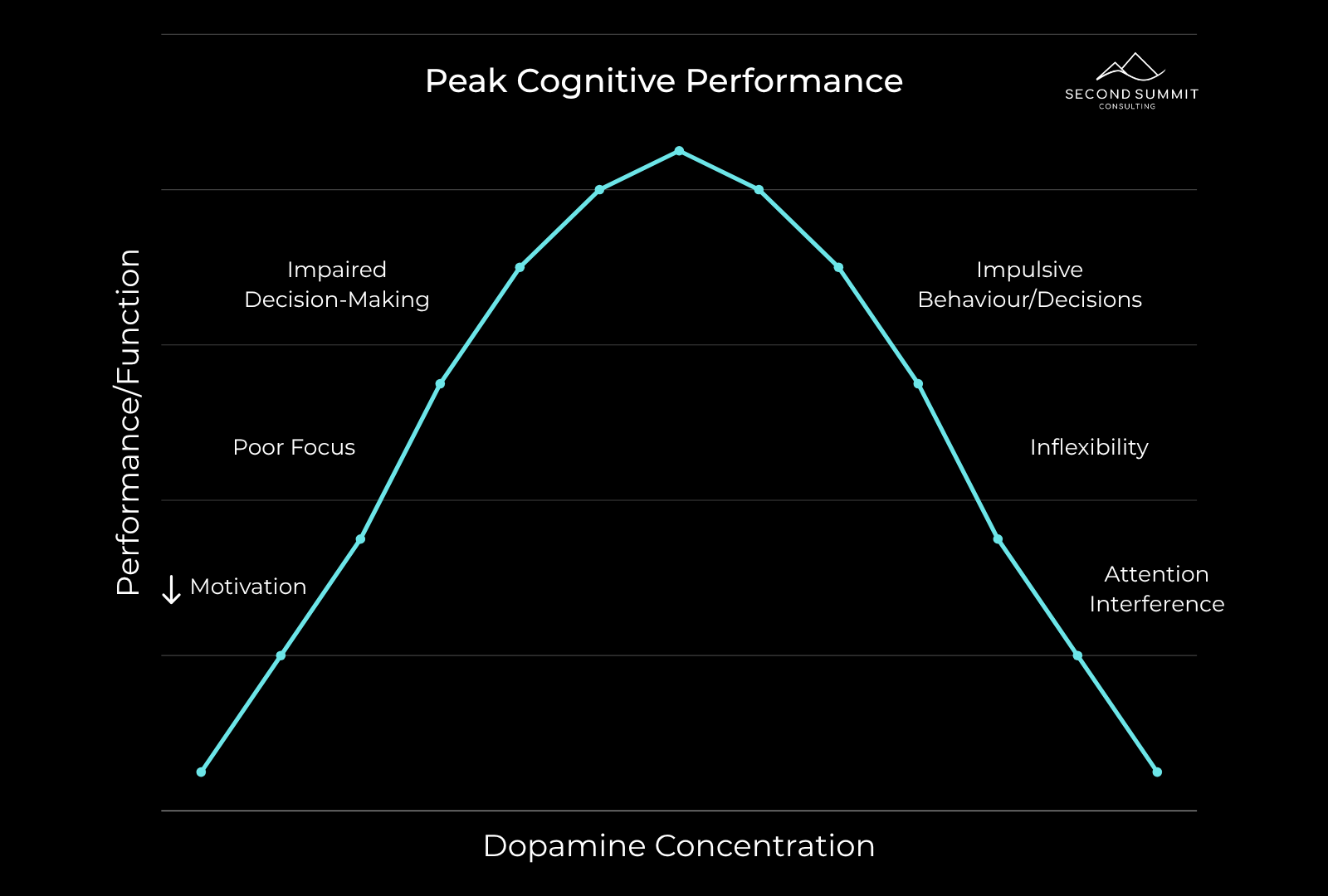
Dopamine is one of many signalling molecules in the body where there is an optimum concentration/activity level and falling either side of that is detrimental. This is called an Inverted-U curve. For executive function:
- Too little = reduced motivation, poor focus, impaired decision-making
- Optimal = Peak cognitive performance, sustained attention, effective decisions
- Too much = Impulsive behaviour and decisions, inflexibility, cognitive interference
This response and what 'normal' baseline levels are for someone are highly individual and affected by a range of genetic factors.
If you take one thing away from this section it is this: dopamine is highly complex and involved in a huge range of functions. Simply increasing, or decreasing it is not the answer. The answer is supporting healthy dopamine metabolism.
Healthy Dopamine
To talk about optimising healthy dopamine, I have create a science-backed guide broken into making dopamine, using dopamine, and getting rid of dopamine.
Making Dopamine
To make dopamine, we need to ingest (eat) its raw components, digest them, move them to the brain (dopamine itself cannot cross the blood-brain barrier), then make dopamine in the brain where it needs to be made.
Essential Precursors
- L-Tyrosine: The direct building block of dopamine
- Found in: High-protein foods (meats, eggs, dairy, legumes, nuts)
- Generally easy to get enough if hitting your protein targets (1.5+g/kg bodyweight of protein)
- Note: Effects are baseline-dependent—most beneficial when under stress
Critical Cofactors
- Iron: Required for the rate-limiting enzyme in dopamine synthesis
- Ensure adequate levels through blood work, not random supplementation
- Vitamin B6: Helps convert L-DOPA to dopamine
- Found in: Fish, poultry, chickpeas, bananas
- Required dose: Typically met through diet; supplementation if deficient
- Vitamin D: Regulates dopaminergic neuron health and COMT (an enzyme involved in dopamine metabolism) activity
- Get levels tested (aim for optimal range, not just "not deficient")
- Supplementation shown to increase dopamine in deficient individuals
- Magnesium: Complex modulator with regulatory effects
- Found in: Leafy greens, nuts, whole grains
- Supports overall neurological function. If supplementing, look for what it is chelated with, aim for threonate for maximum blood-brain penetrance
- Zinc: Modulates dopamine transporter function
- Found in: Oysters, red meat, legumes, nuts
- Particularly relevant if you have high physical or cognitive demands
As with dopamine, many of these nutritional factors are not simply more is better. This is where using bloodwork is helpful, aim to fill any gaps with whole foods , supplement if easier. I get a reasonably full panel done yearly with a smaller panel every 6 months (for the kiwis out there, check out BodyIQ where you can order your own bloods based on biomarkers you'd like to track without the need for a doctor’s referral, iMedical is the equivalent in Australia).
Using Dopamine
As we discussed above, simply 'maximising' or 'minimising' dopamine won't be helpful. We need to support healthy, natural dopamine release. Here are some dos and don'ts to help support a healthy release of and response to dopamine in your brain.
Exercise: Of course exercise was going to be here. Exercise regulates the D2 subtype of dopamine receptor and increases dopamine sensitivity in them which supports overall dopamine function in a range of areas.
Sleep: Sleep deprivation drops D2 receptors by 15-20%. Dopamine also influences sleep-wake cycles which, combined, create a nasty loop. As with most things to do with the brain, getting enough, good quality sleep is paramount. Prioritise this.
Stress Management: Acute stress boosts dopamine for acute performance. Chronic stress depletes dopamine. Remember the stress system was built for an on/off stress situation not a constant basal level of it. Build your recovery and work periods respecting this principle.
Supernormal Stimulation: This refers to extreme forms of stimulation such as scrolling social media or modern gambling. They hijack what Michael Easter calls the 'scarcity loop' with unpredictable rewards (the strongest form of conditioning), low-effort (conditions your brain to seek 'cheap' dopamine without much effort), and continuous novelty. If you haven't already, I highly recommend both of Easter’s books - The Comfort Crisis and Scarcity Brain. I also talk about this in the previous newsletter edition on dopamine sensitivity.
Healthy Novelty: Instead of seeking novelty in games, gambling, and social media, seek it in experiences that engage a range of senses and involve learning such as reading, learning an instrument, cooking classes, walking in nature.
Caffeine: Caffeine indirectly stimulates dopamine release. Use this information to plan your caffeine strategically considering your focused planning sessions and dopamine load. If you got that cuppa at the start like I suggest you'll be experiencing a little of that now!
Social Connection: Rich social interactions have a wide range of benefits including supporting dopamine function. Prioritise interactions with both new and familiar people with the following hierarchy: In person > Video call > Phone Call > Message. Science has shown a variety of neurological benefits of interacting with people in person that are absent in video and other forms of interaction. This recent study found that holding a romantic partner’s hand while experiencing pain produces pronounced analgesia. Meanwhile, this paper found that a hug reduces cortisol levels. Go see your friends.
Chilling Out: It wouldn't be an article on dopamine if it didn't talk about cold plunges. After the above lesson on dopamine you might think that a sudden 250% boost in dopamine isn't what we are after after all. The difference is, cold exposure produces a healthy increase in a cocktail of neurochemicals to produce an overall adaptive stress response. Unlike the rapid spike-and-crash pattern seen with many dopamine-stimulating behaviours (social media, substances), cold exposure produces a prolonged, sustained release of dopamine that can last for hours after the exposure. This adaptive response stabilises the levels of a range of neurochemicals. Andrew Huberman has done a write-up about this here.
Clearing Dopamine
Once dopamine is produced and released, it then needs to be cleared. This prevents overstimulation, receptor downregulation, and oxidative stress. To aid with healthy clearance several familiar characters appear:
- Exercise: Helps clear dopamine (study here)
- Sleep: Sleep is critical for the glymphatic system to function (being most active in deep sleep) which clears the brain of toxins and metabolic by-products
- Hydration: Dehydration impairs the glymphatic system
Further, avoiding unhealthy interaction with dopamine-rich activities (scrolling social media, gambling etc.) prevents over production in the first place.
The Complete System Perspective
Integration: Healthy dopamine metabolism requires all three components working together:
- Making: Adequate nutritional substrates and cofactors
- Using: Balanced engagement with natural rewards and avoiding hijacking
- Clearing: Quality sleep, movement, and avoiding overstimulation
The Take-home
Peak performance (or even mental health generally) isn't about more or less of dopamine, it's about engineering a lifestyle that engages with the natural functions of dopamine in a healthy way. Dopamine is an incredibly powerful neurotransmitter and knowing its ins and outs empowers you to get the most from it. See the Complete System Perspective above for the TL;DR. For more reading on the topic you can also read Dopamine Nation.
I'd love to know your thoughts in the comments to help me fine-tune the content to make it most relevant.