
Sharpen First, Swing Later: The Intervention Hierarchy for Peak Performance

Abraham Lincoln understood leverage: 'Give me six hours to chop down a tree and I'll spend the first four sharpening the axe.' This isn't about work ethic. It's about physics. The sharpness of your tools creates more leverage than your technique, cadence, or mindset combined. Welcome to part three of my manifesto ‘Psychology follows Physiology: Intervention Hierarchy. (Find the overview here and part one: ‘’Biology as your Operating System’ here).
Bottom-Up vs Top-Down
When optimising human performance (be that athletic or cognitive) it is generally approached in one of two ways - Bottom-up or Top-down. Bottom-up starts with physiological foundations optimising parameters like sensory processing, autonomic function, and metabolic functions. Top-down begins with higher level psychological strategies such as mindset and cognitive techniques. The research is clear - Bottom-up consistently outperforms top-down. The order of intervention matters for the durability of improvements.
This randomised controlled trial assessed whether performing bottom-up training followed by top-down was more effective than the reverse for cognition. The results found that “bottom-up/top-down training has the most endurable effects, which reveals the importance of the order of application of the exercises for gains in cognition.”
This study found that targeting bottom-up and top-down training not only improved cognition but found increased serum brain-derived neurotrophic factor (BDNF) and altered D-serine/total serine ratio, both linked to enhanced cognition and quality of life.
While there is no doubt that mindset and cognitive training are integral for peak performance, if you are not targeting bottom-up as a foundation you are leaving performance on the table and making the process less efficient.
Let’s Get Phys(iolog)ical
You wake up refreshed and energetic. You build some movement and great breakfast into your morning and capture some morning daylight. You sit down for a deep work block almost excited to work. Get your physical and physiological foundation right sets you up for effortless effort.
But this goes beyond anecdotes. Research into this area has shown that getting the physical right itself has cognitive benefits but it also increases the effectiveness of psychological interventions. At the very basic level, physical exercise is powerful for mental health.
This 2023 systematic review looking at 97 reviews covering 1039 trials involving over 128,000 participants found that “physical activity is highly beneficial for improving symptoms of depression, anxiety and distress across a wide range of adult populations, including the general population, people with diagnosed mental health disorders and people with chronic disease. Physical activity should be a mainstay approach in the management of depression, anxiety and psychological distress.”
A review in older adults found that meditation and mind-body exercises improve cognition. This study in adolescents found that physical activity was as effective as cognitive training at improving a range of cognitive measures with a combination of both being the most powerful.
It is well documented that exercise also primes the brain for learning:
- Increased blood brain flow increases cortical activity
- Exercise stimulates BDNF which is important for neural function and plasticity
- Catecholamine release (dopamine, norepinephrine) which improves learning and cognition
- Specific myokines can enhance neural plasticity
Embodied Cognition Interventions
Further evidence for sharpening your axe first comes from research into embodied cognition for peak performance. This fascinating study looked at the effects of embodied and cognitive interventions of the experience of flow and cognitive patterns in over 300 adolescents. The embodied intervention in this case was breathwork. The study found a range of interesting findings including:
- Breathing exercises might integrate bodily, emotional, and environmental information by enhancing proprioception for better emotional regulation
- The cognitive patterns in the Embodied Task Group enabled participants to be more aware of state changes, facilitating self-awareness and self-regulation
- It is likely that the breathing exercises in the Embodied Task Group provided direct physical sensations and multisensory information, potentially alleviating cognitive fatigue and enhancing the flow experience in this dimension [the unambiguous feedback aspect of flow]
- Embodied interventions might disrupt cognitive inertia and increase awareness to diverse information
- Embodied interventions might expand cognitive openness through bidirectional feedback, offering more problem-solving opportunities for adolescents. Cognitive interventions’ focal-event mode might cause cognitive narrowing, restricting adaptability to complex environments
A large meta-analysis looking at 50 intervention studies combining over 6,000 healthy adults found that “performing cognitive and physical exercise simultaneously, and interactive training (e.g., exergames, square stepping) produced the largest gains in executive functions, speed, and global cognition, as well as the largest improvements in physical functions. Aerobic training was associated with higher effects in attention and fitness, whereas non-aerobic training produced larger effects in global cognition and balance.”
Lastly, a study assessing the role of embodied cognition to enhance the effectiveness of cognitive behavioural therapy concluded that the “integrated embodiment approach with CBT enhances outcomes across a wide range of emotional disorders”. The paper also states that “embodiment techniques offer simple, fast and significant effects and a new understanding that explicitly changes the level at which negative material is processed.”
These studies reinforce the idea of setting up a solid physiological foundation to execute traditional top-down strategies more effectively and more efficiently. The well sharpened axe will not only get through the wood faster but will do it with less effort.
The Intervention Hierarchy Pyramid
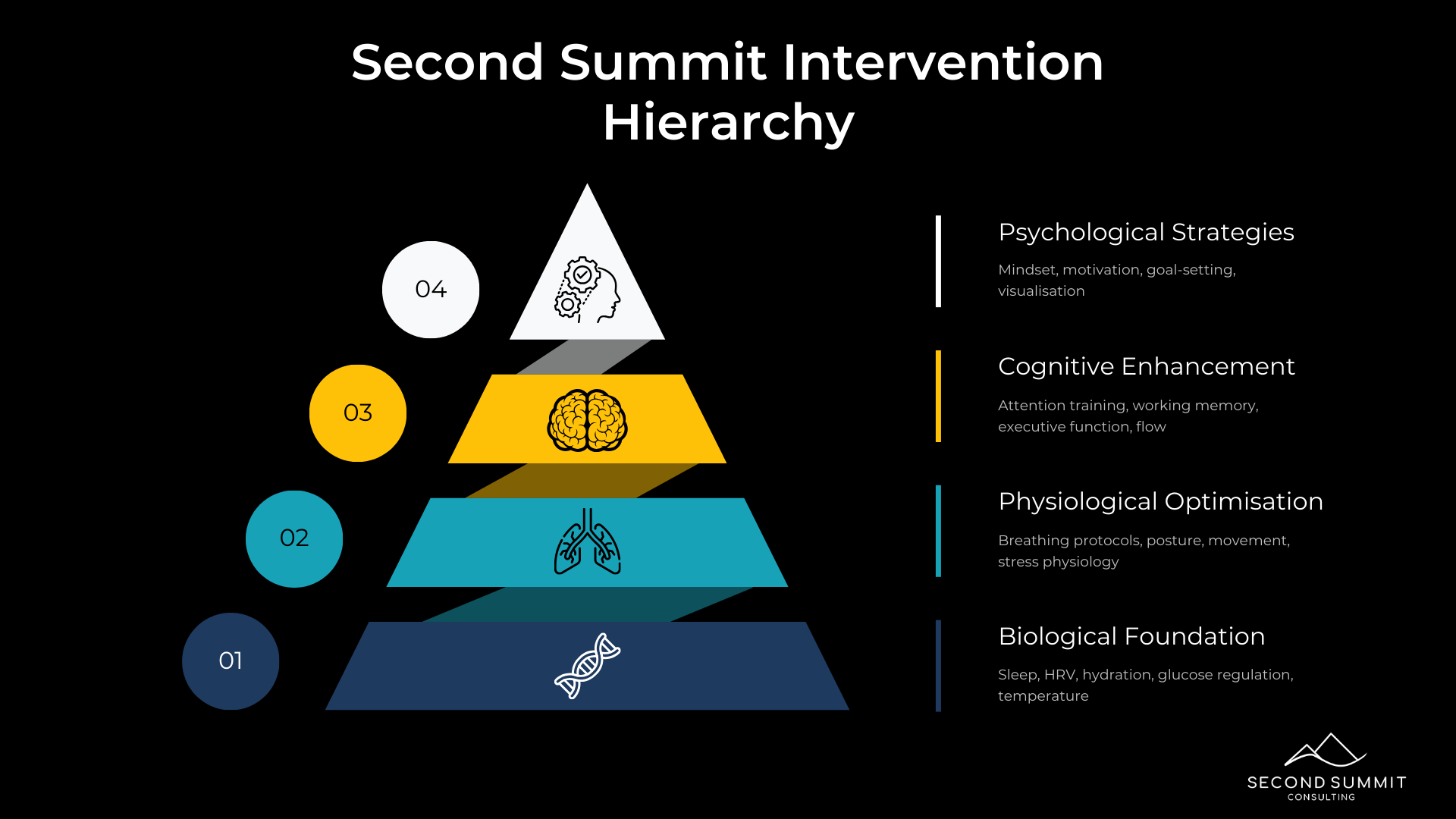
So what does ensuring the quality of the axe look like in practice .I focusing on a layered approach where the fundamentals are optimised to A) provide a foundation for additional building and B) scale to produce improvements in all other layers automatically. The Second Summit Ascent program builds each of these into it’s modules.
Layer 1: Biological Foundation
The focus starts at layer one. This ensures your fundamental biology is functioning well and in a position to support the layering of additional work on top. This is ensuring the axe head is attached well to the handle and the the handle is structurally sound. That it wont fall apart on the first swing. This includes optimising sleep, HRV, hydration status, glucose/nutrition etc.
Layer 2: Physiological Optimisation
This layer introduces physical interventions to optimise your physiology. This includes breathwork protocols, posture and movement, and optimising stress physiology. This is reinforcing the axe handle, ensuring it’s smooth, able to wielded effectively, and can be swung effectively.
Layer 3: Cognitive Enhancement
Here we introduce protocols to improve the bottom-up processing of the brain. This includes optimising executive function, working memory, and attention. Think flow, meditation, attention residue reduction training. Here we are sharpening the axe head. We know its structurally sound, we know we can swing it effectively, now we making sure the blade is sharp and true.
Layer 4: Psychological Strategies
The final layer is ensuring the person swinging the axe wants to swing the axe, knows how to swing the axe, and, importantly, knows why they are swinging the axe. This is the point at which we introduce mindset training, motivation work, goal-setting and visualisation.
Why other approaches are short-lived
A C-suite executive running on 5 hours of sleep, elevated cortisol, and chronic HRV suppression who invests in executive coaching, visualisation, and goal-setting workshops is the burliest axeman swinging the flimsiest axe. The axe shatters on first strike. Yet this is precisely where most executives begin their performance journey – at Layer 4, while Layers 1-3 actively erode.
Measure What Matters
Each layer requires objective measurement. Layer 1: HRV trends, sleep architecture, glucose stability. Layer 2: Breathwork coherence, postural assessments, stress recovery rates. Layer 3: Flow state frequency, attention residue scores, working memory benchmarks. Layer 4: Values alignment, motivation indices, goal clarity.
This measurable optimisation, the third pillar of the Psychology Follows Physiology approach, is what transforms the pyramid from theory into practice. Next week, I'll show you exactly how to track, adjust, and accelerate progress through each layer for a structured, complete, future proof approach to peak performance.