
Two Systems, One Behaviour: What Has to Change for a Habit to Hold
My wife and I were speaking the other day about how we both want to read more, to make it more of a habit. We both knew we wanted to, knew it would benefit us immensely, and yet neither of us could make reading a 'habit'. I see this a lot with my clients, they often know what they should do, and might even manage to for a stretch but then a slight change in situation and the habit drops off.
We've all experienced it. Pop-science tells us we just need to stick with it for 66 days (or is it 21, depends who you read) and then, bam, the habit is locked. But, as you might expect, the neuroscience is much more complex and far less dependent on time or streak than you might have imagined. An understanding of the neuroscience of habit formation both explains why, no matter how hard we try, some things don't stick and perhaps what we can try to help them stick.
Two Systems, One Behaviour
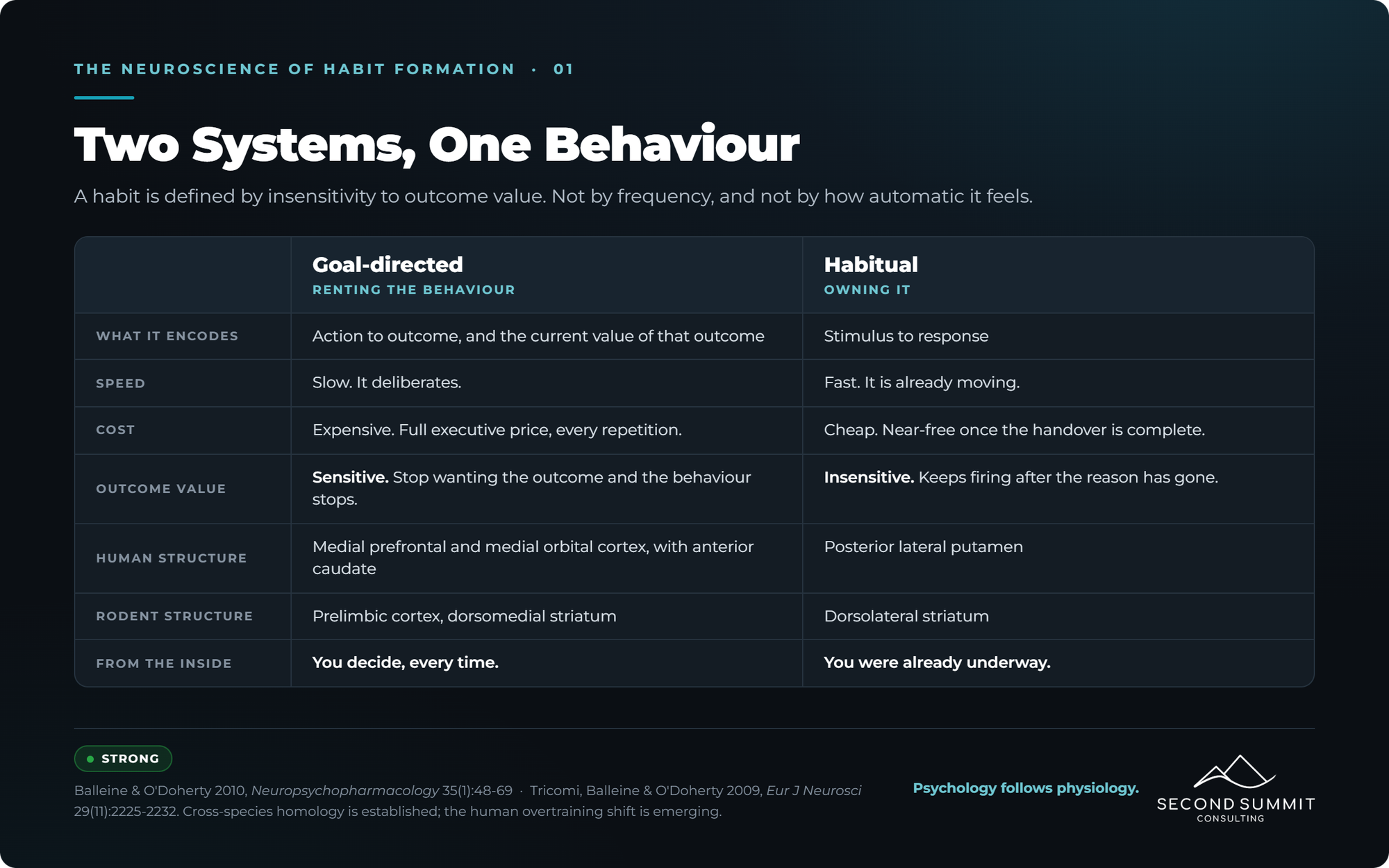
Instrumental behaviour runs on two anatomically distinct systems that actually compete for the same motor output. The goal-directed system encodes the action-outcome link and the current value of the outcome. In English, this system weighs the action against the outcome and that outcome and makes a decision as to whether the value of the outcome warrants the action. Going to the gym, this system weighs the effort of the action (getting changed, walking to gym, working out etc) against the outcome value (increase of health, increase in self-confidence etc) before setting the action in motion. This system is highly flexible, is expensive, and is sensitive to the outcome (if there is no outcome then the action isn't worth it). The habitual system encodes stimulus-response (not action outcome). This system is fast, cheap, and is not sensitive to the outcome. From a neuroscience perspective, these two systems live in different areas of the brain. The goal-directed system depends on the medial prefrontal cortex, the medial orbital cortex, and the anterior caudate while the habitual system involves the posterior lateral putamen.
This is an important distinction because it defines what habitual actually is. A good axiom to test this is - If I stopped wanting the outcome tomorrow, would the behaviour stop too? If the answer is yes, then the behaviour is still living in the goal-directed circuit. If, even after not wanting the outcome anymore, you would still likely do the behaviour then it's shifted into the habitual system. For example, when you are waiting for your coffee to be made you may want to check your phone to see if you have any emails (goal-directed). After doing this for a while, you may unconsciously get your phone out (even if its off) when waiting in line (habitual). Your phone will be coming out of your pocket before you are even aware of it. To be a habit, it is insensitive to outcome. So the question here isn't about motivation but about which system is driving.
The Handover: Goal-directed -> Habitual
The handover from goal-directed to habitual has nothing to do with strengthening resolve. It requires repetition and, critically, requires repetition in a stable context. A completed handover is not just convenience but also a permanent(ish) reduction in executive requirements (less decisions and deliberation).
Interestingly, work with rodents (there is excellent interspecies transferability of this handover so likely translates well) has shown that repetition alone does not stamp the habit in. A prefrontal structure needs to participate while it happens. When these structures were prevented from participating, no amount of repetition caused the habit to stick. This is again where we see psychology following physiology. This precondition is exactly what a stressed, under-slept, cognitively overloaded leader lacks. For a range of reasons it is difficult to study habits experimentally in humans (de Wit et al. (2018)) failed five times across four habit inducing paradigms), however one study with 306 participants found no statistical evidence that the amount of time spent 'training' the habit affected habit success (Pool et al. (2021)).
My read of this is that, because of the highly variable nature of the modern work environment, a 'stable context' is rare. Therefore, the modern leader never gets a chance to complete the handover from goal-directed to habitual unless careful thought goes into the context in which a habit is being anchored.
The Habit Might be There; But Overridden
A fascinating paper published in 2019 has shown that there may be a hidden arms race happening. This paper argues that the stimulus only primes the habit response and, given enough time and mental bandwidth, the goal-directed system will come up with something that over rides it. In fact, they found that when forced produce a response rapidly (300-600ms) the habits were there but given longer the participants would do something different. This likely explains A) the de Wit et al. observation above and the fields difficulty reproducing consistent results (people were typically healthy, rested, and unhurried) and B) why some habits sticking and some not can seem so variable. It's useful to reframe this away from discipline/willpower and towards what other behaviours are competing and under what circumstances are you trying to build the habit into.
An interesting, albeit preliminary, finding from Pool et al. was when they had a look at stress and the effect on habit formation they found that the affective aspects of stress (anxiety, worry, isolation, and discontent) impacted habit acquisition. Participants high in affective stress showed outcome-insensitive responding after only moderate training, and extra training changed nothing further. Participants low in affective stress behaved goal-directedly early on and only became habitual with extended training.
Read that carefully, because the obvious interpretation is the wrong one. The stressed group had not built habits faster. The authors are explicit that these participants were never sufficiently goal-directed at the start for a shift to be visible. There was nothing to hand over. This aligns well with the competition model: with less stress there is prefrontal capacity available, so the goal-directed system can compete, and stress removes that capacity. It also explains why people fall back on old habits under pressure, before any new habit has been formed.
The read on this is that pressure reveals your current defaults (which I think we have all experienced), the question then becomes what does pressure do to your ability to install new defaults.
Psychology Follows Physiology
Acute stress shifts control from goal-directed to habitual, and it runs deeper than "stress makes you tired so you have less energy and try less." The mechanism is actually quite specific. Schwabe et al. (2011) found that propranolol (a beta-adrenoceptor antagonist that blunts noradrenaline signalling, including centrally) completely blocked the stress-induced shift. The following year, the same group showed that hydrocortisone (mimicking the cortisol stress response) combined with yohimbine (an alpha-2 antagonist that increases noradrenaline release) produced the same stress-induced shift and, importantly, neither alone did, only in combination. This shows there is some very specific pharmacology behind the effect.
Further work in the area has shown that chronic stress structurally remodels the brain and biases towards habitual over goal-directed. This structural remodelling involved several brain regions including the medial prefrontal cortex and the sensorimotor striatum. Another angle looked at sleep. A night of total sleep deprivation impaired the formation of goal-directed control but left the expression of already-acquired behaviour intact. Reduced ventromedial prefrontal cortex activation was the neural correlate, and in the sleep-deprived group only, how goal-directed someone stayed tracked their baseline working memory capacity (r = 0.463, p = 0.020).
This is relevant because a tired leader can run the status quo but will struggle to override it.
I want to be careful with this one. It is 47 people, and the key effect sits at p = 0.040. The authors also note they cannot fully separate sleep loss from circadian timing, because the deprived group was tested at a different point in the body clock. So I read it as directionally consistent with the pharmacology above rather than a result that stands on its own.
A caveat to mention that, as described before, habit testing in humans is notoriously difficult as described here where the authors show contesting effects and discuss some possible reasons why (likely paradigm and study design rather than counter evidence). So read this as deploy with caveats, there is real mechanistic detail here and directional convergence from both pharmacology and structural neuroscience but the field is still moving.
The Missing Piece
Habits are bound to cues, not a person. They live in the world around you, not within you. The habit is attached to a room, a time, another action. This is why time away from home or the office can derail habits if the habits were cued to those areas. Students transferring universities kept their exercise, newspaper, and television habits only where the features of the performance context survived the move. 115 students were tracked. Exercise habits held where they trained in the same kind of location at both universities. Newspaper reading held where they carried on reading it with other people.
The context that mattered was not only physical. A change in a roommate's own newspaper reading was enough to disrupt the student's habit. In fact any change at all in the presence of others disrupted performance, whether people started joining in or stopped. Adding someone is as disruptive as losing them.
That is worth sitting with if you lead a team. A new direct report, someone leaving, a reshuffle. Nothing has physically moved and the cue is already gone. A study of 30,110 gym members across 560 gyms and 12 million check-ins found that the best predictor of attendance was "the most important predictor of gym attendance across individuals is how much time has passed since the previous gym visit (“time lag”)". This finding bore out in three ways 1) time since last visit was a negative predictor for 76% of people, b) day-of-week streaks were a positive predictor for 69% of people, and 3) attendance in the last seven days was a positive predictor in 82% of people. The authors are careful to note these are directional rather than significance-tested, because of the modelling approach they used.
The same is true the other way around. Disruption opens a window to remove old habits and establish new ones. A field experiment with 800 participants found a behaviour change intervention significantly more effective among recently relocated households, with the window estimated at roughly three months. In 18,053 UK survey respondents the effect decayed as time since moving increased.
Senior roles are cue-hostile by design. Travel, reorgs, offsites, calendar chaos, new teams, evening work. There are likely 10s of contexts throughout a work day which makes the elusive 'stable context' ever more elusive. It also explains why some habits stick without issue (flossing after brushing teeth) and some seem impossible (eating healthy). The three month window finding above is instructive. Don't wait for stability, use this period to set the habit forming.
The more practical takeaway here is this: anchor the behaviour to a behaviour in a chain (that survives context) not a location or time. Waking up, brushing teeth, eating breakfast (if you do), going to the bathroom. These are consistent behaviours that survive context. The second study in that same paper, which tracked handwashing among 3,124 hospital workers, found that "...the median time to habit formation was on the order of a couple of weeks (habits typically formed after 9 to 10 shifts or about 220 washing opportunities). This is much faster than the habit formation measured in study 1 of gym attendance, where the median time to habit formation was 4 to 7 mo."
21 days or 60 days?
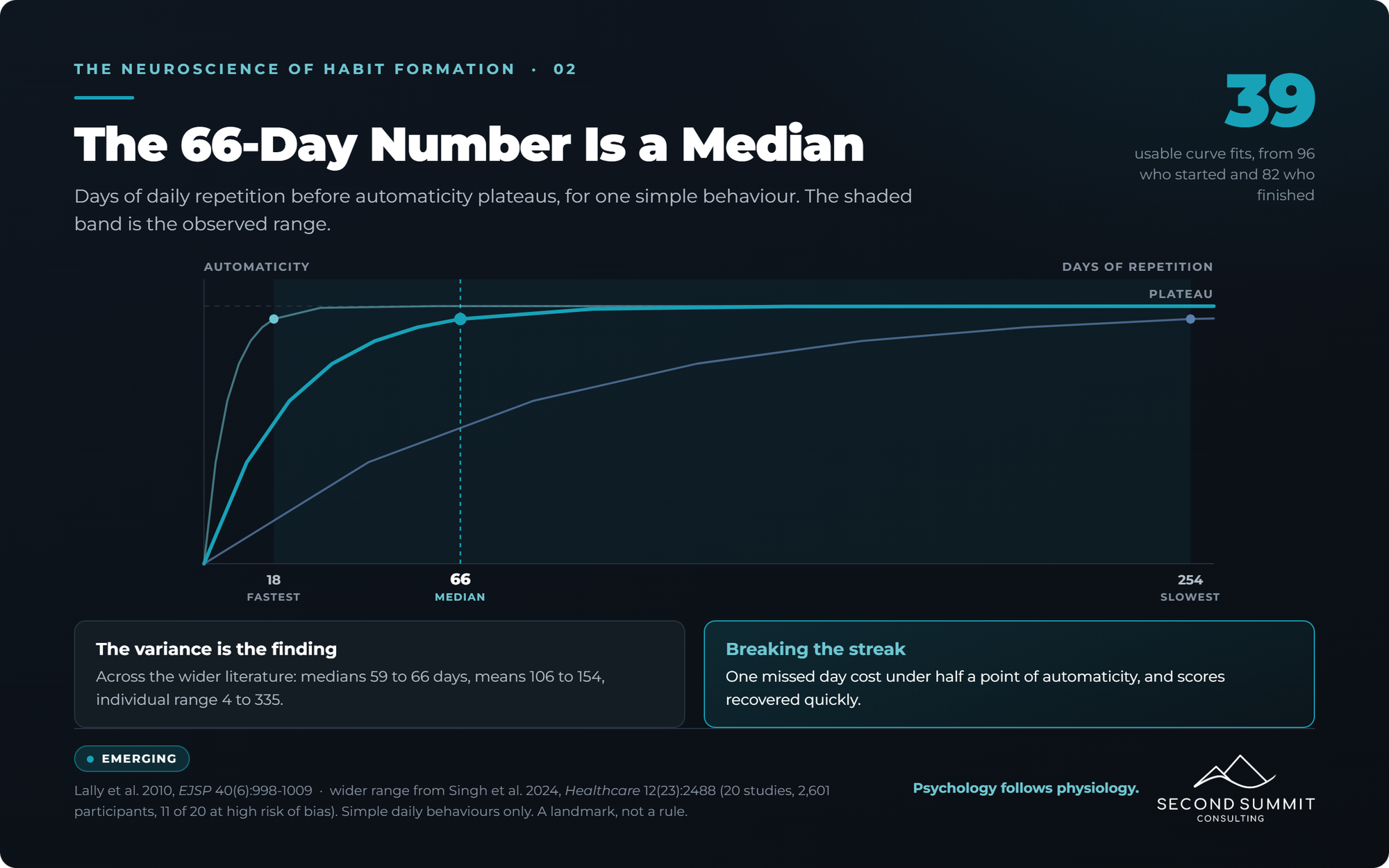
So how long should we expect the handover to habitual to occur? Well first, let's look at what is commonly bandied about. 21 days comes from a 1960 self-help book and not research. 66 days was a median (with a range of 18 to 254 days) from a study where only 39 of a possible 82 participants habit-forming data was usable and this was looking at simple daily behaviours. Exercise takes around 1.5x as long as eating or drinking. In one healthy eating study only 23% of participants ever reaching the habit threshold. A 2024 systematic review on habit formation found a range of 4 - 335 days showing no clear 'rule'.
The evidence shows domain dependent habit formation. Simple, single-step, immediately-rewarded behaviours habituate fast. Complex, multi-step, delayed-payoff behaviours do not (hand-washing versus gym attendance). Habit formation over time data also shows decay. So be wary when being presented with a '30-days to a new you' program. So be patient and persistent and use cues that survive travel, away days, and chaotic meeting days.
There is some good news. Streak tracking is a common motivational tool used to encourage habit formation. "Don't break your streak." But commonly, once people break their streak they give up altogether. Lally et al. (2010) found that missing a day in a streak resulted in only half a point of automaticity loss with rapid recovery. So do not treat a broken streak as starting again from zero. It is not.
So if it's not time, then what?
The Strategy That Works (and which don't)
You might have heard this one before. And it's not an old wives' tale. Don't make working out a habit, make putting on your gym shoes a habit. A 'habit' can be separated into two components. The instigation habit (the cue triggering initiation of behavioural sequence) and the execution habit (the actual sequence itself running automatically once started). Work from Phillips & Gardner (2015) then replicated by Kaushal et al. (2017) showed that rather than automating the execution habit (doing the same gym routine) you should focus on automating the instigation habit (having gym clothes packed and shoes laid out), intention and prep habits positively support behaviour execution. This is a small but important distinction. And while automating the gym routine does have benefits, from a purely habit sticking perspective, coupling the cue to the instigation is the best bet.
Bürgler and colleagues (2026) pre-registered a reanalysis of a six-month longitudinal habit study (N = 254) and found two distinct trajectories, habit formation and habit degradation, with cluster membership differing by behavioural complexity, frequency and context stability. Six determinants were significantly associated with habit strength: autonomous motivation (you want the habit, not someone else saying you need it), behaviour frequency (how often you are doing it), context stability (described above), feeling energised, feeling pleased, and perceived difficulty (negative).
The willpower myth is dead. It failed a large, 23-laboratory pre-registered replication study with Cohen's d of 0.04 (almost indistinguishable from zero effect). Expanding on this, Galla & Duckworth (2015) found across six studies and 2,274 participants that habits mediated the relationship between trait self-control and outcomes, including objectively measured grade point average and first-year college persistence. Which essentially means the people you think have iron discipline are not out-resisting you. They have arranged their week so resistance is rarely required.
Want to tell everyone about your new habit goal to make it stick? While social failure can be a motivator, be careful with how you manage it as social reward may be linked with a reduction in effectiveness. Worth flagging that this one is soft: in the same meta-analysis the association only appeared once the model was adjusted for follow-up duration, so treat it as a caution rather than a finding. Ensure accountability is the driver, not likes on your post about it.
So let's translate these into protocols that work
The Protocols
PROTOCOL 1: The Anchor Test
1. Choose one behaviour. One.
Not three. Habit formation interventions produce a real but modest effect, roughly a third of a standard deviation in habit strength across the controlled trials. Spreading something that size across three behaviours is how people end up with none.
2. Find a genuine anchor, not a clock time.
Your anchor is an action you already perform every day that reliably comes just before the slot you want. "After I put my laptop in the bag" beats "at 5:30pm". In the gym data covering 30,110 people, the strongest predictor of whether someone turned up was what had happened recently, not what time it was. Anchor to a behaviour in a chain, not to a number on a clock.
3. Define the sixty-second version.
Whatever the behaviour is, decide the smallest recognisable start of it. Shoes on. Notebook open, first line written. Book on the bench next to the coffee. This is the part that predicts whether the behaviour happens at all.
4. Run it on every anchor exposure for ten weeks.
The full behaviour is optional. The sixty seconds is not.
5. Use a missed-day rule, and decide it now.
One miss: do nothing, resume tomorrow. A single missed day costs almost nothing and recovers quickly. Two consecutive misses: do not have a motivation conversation with yourself. Audit the anchor. Something about it has changed.
6. Review at week four and week ten.
At week four you are checking that the anchor is firing reliably. You are not checking whether it feels automatic yet. At week ten you are checking whether you start without deciding to.
How long to give it. Ten weeks minimum. If the behaviour is complex, expect considerably longer. Gym attendance measured objectively took four to seven months to plateau, and in the classic diary study exercise habits took around one and a half times as long as eating or drinking ones. If you have a choice, put it in the morning. One study found the same stretching protocol took about 106 days to become habitual in the morning and 154 days in the evening. That is a single study, so treat it as a nudge rather than a rule.
What to track. Two things, weekly. First, the behaviour itself: did it start, on how many of the available anchor exposures. Second, one question rated 1 to 5: "I start this without deciding to." Track both, not just the second. Self-reported habit strength correlates only weakly with what people actually do, so the count is the honest measure and the rating is the direction of travel.
Who this is for. Anyone with a reasonably stable weekday shape who has tried and failed to establish a specific behaviour.
Who should modify it. If your anchor is itself unstable, because you travel more than one week in four or your start time swings by more than an hour, fix the anchor before you fix the behaviour. Building onto an unstable cue is the failure mode this whole piece is about.
One caution. If-then planning buys speed and costs flexibility. In a controlled test, if-then plans helped people learn the behaviour but made them worse at adapting when the situation changed. So automate the initiation, not the decision. In a volatile environment you want the start to be automatic and the judgement to stay awake.
PROTOCOL 2: The Green Light Gate
Run this before Protocol 1, not after it.
1. Take a two-week baseline before you start any habit work.
Four numbers a day. Hours slept. How rested you felt on waking, 1 to 10. Perceived stress, 1 to 10. Minutes to settle after something stressful.
2. Apply the gate.
Do not start a habit build until, across fourteen consecutive days: sleep is above seven hours, rested on waking is above 7 out of 10, your last caffeine is before 2pm, perceived stress is below 6 out of 10, and you are settling in under thirty minutes.
3. If you fail the gate, fix the gate.
Caffeine cut-off. Daylight in your eyes before 10am. A shutdown ritual that actually ends the day. One block of slow breathing. These are not the warm-up for the habit work. They are the prerequisite.
4. Re-test, then begin.
How long it takes. As long as it takes. There is no ceiling on this, and treating it as a delay is the wrong frame. You have already spent attempts on habit builds that could not have worked. This is how you stop spending them.
What to track. Sleep duration, how rested you feel, perceived stress, and how long you take to settle. Add heart rate variability and resting heart rate if you wear something that measures them.
Who this is for. Anyone who has failed at habit change more than twice while under sustained load. If you have failed repeatedly and you are averaging six hours of sleep, the habit was never the variable.
When to see a doctor instead. If you have insomnia more than three nights a week for two weeks, if you gasp or choke in your sleep, if you have chest pain or severe palpitations, panic attacks, or persistent hopelessness, this is a clinical matter and not a performance protocol. See your GP first. That is not a judgement about your capability. It is the correct order of operations.
The honest limitation. Nobody has run the direct experiment. No study has tested whether improving sleep and stress regulation before a habit intervention makes the habit more likely to form. What we have is three lines of evidence pointing the same way: one night of total sleep deprivation impaired the formation of goal-directed control while leaving already-learned behaviour intact; blocking one arm of the stress response prevented the shift to habitual control, and reproducing both arms together caused it; and people high in chronic anxiety and worry showed no goal-directed control to lose in the first place. That is good mechanistic reasoning and it is how I sequence client work. It is not a trial, and I am not going to present it as one.
Two more, if they apply to you
If you have a context change coming, a new role, an office move, a restructure, a return from long leave, that is your best ninety days. Do the cue work in the first fortnight, before the new context sets, and install two behaviours at most. Most people wait until they have settled in. Settling in is the habit forming, and it forms around whatever you happen to be doing at the time. Reply and I will send you the full protocol.
If you travel more than one week in four, a location-based anchor will not survive, and rebuilding it every time is not a discipline problem. Anchor to something that travels: an object you always carry, or a fixed point in a sequence you always perform. Reply and I will send you that one too.
Saveable image below. Download and keep/share as you need.
Close
So we decided that book and morning coffee was the play to get more reading in. We have a coffee at some point every morning. The books are sitting where we would normally have our coffee. Taking our books travelling will ensure the habit travels with us.
Remember, this is not about willpower and motivation it is about setting up the protocol, the environment, and your physiology to maximise handover from goal-directed to habitual.
Under pressure you become your defaults.
What anchor are you going to use to attach your habits to? How stable is it?
