
What Is Your Feed Teaching You?

First, you might (or might not have) noticed a quiet period. Rehabilitation from complex knee surgery is taking a fair component of my days and I was finding I wasn't able to commit as much time to reading and writing. So please forgive the delay.
In the habit edition, I wrote about my wife and me wanting to read more. We both knew we wanted to do it, and we could see the benefit. Getting it to happen consistently was the difficult part. We decided to put our books where we normally have our morning coffee.
I've been thinking about that same question in relation to social media. What have we made easy to do, and how much of the day are we happy to give it?
Picture opening your phone to reply to a message. A video catches your attention, you watch another, and by the time you put the phone down the message is still unanswered. You went in with a fairly simple job to do and somehow ended up watching someone renovate a kitchen.
The question that interests me is what we might be learning through that repetition. If we keep moving on the moment something becomes less interesting, could we be getting better at moving on? And could that make staying with a slower task more difficult?
The evidence is still developing. There are reasons to take the concern seriously, alongside some fairly large gaps in what we can claim. I think there is enough here to reconsider the place we give feeds in our day, particularly when using them has become automatic.
Why We Keep Coming Back
Michael Easter describes the “scarcity loop” in Scarcity Brain (Michael's books The Comfort Crisis and Scarcity Brain are amazing, go read them if you have not). There is something worthwhile on offer, you don't know when you'll get it, and you can try again immediately - Like a slot machine. A social media feed fits that description quite well. Most posts may do very little for you, but the next one could be interesting. Finding out takes almost no effort.
That is Easter's explanatory framework. He sets it out in this interview. To understand how much scientific weight it can carry, we need to look at the components.
Lindström et al. (2021) analysed more than a million social-media posts from more than 4,000 people. The timing of posts fitted a reward-learning model. In a separate experiment with 176 participants, changing the number of likes people received changed how quickly they posted again.
In other words, the response to a post influenced the next posting decision. Social rewards helped shape the behaviour.
This study looked at posting, so it doesn't directly explain what happens when we scroll. It also didn't measure dopamine or establish addiction. It gives us evidence for a learning process that could contribute to repeated use. Calling everyone who checks their phone frequently “addicted” would take us well beyond the finding.
There is a more useful question to bring to your own use. When you open the app, what are you hoping will happen? Sometimes there is a specific person you want to hear from. Sometimes the thing in front of you has become difficult and the feed offers an easy place to go. Sometimes setting this intention can help prevent the infinite scroll.
Can We Train Our Attention?
Attention can be influenced by what we have previously found rewarding.
Anderson et al. (2011) demonstrated this by paying people for finding particular coloured targets. Later, those colours appeared as irrelevant distractions in a different task. They still drew attention and slowed responses, even though attending to them no longer earned anything. In a follow-up within the same paper, the effect remained when participants returned several days later.
The learning had carried over. Something previously associated with reward continued to attract attention when it got in the way of the current goal.
These were laboratory tasks using colours and money. They establish that reward history can shape attentional priorities. How strongly that process contributes to everyday feed use needs its own evidence.
Tam and Inzlicht (2024) give us a closer look at the switching itself. Across seven experiments involving 1,223 participants, they examined the relationship between boredom and moving between or within videos. Participants switched when bored and expected switching to help. In the university-sample video experiments, being able to switch made them more bored; several experiments also found lower engagement.
There is a limitation worth keeping in view. Their attention measure asked how absorbed people felt by the videos. It wasn't a test of how well they could concentrate afterwards. The results also became less consistent in broader adult samples.
Even so, this is relevant to the experience of searching for something interesting and finding yourself increasingly restless.
My read is that repeatedly finding a reward after switching could strengthen the tendency to switch when engagement drops. Reaching for the feed at every difficult paragraph might give us plenty of practice at leaving that paragraph. That is a plausible interpretation of the research. The studies haven't yet established how much it changes our ability to stay with a book or a demanding piece of work over time.
What Does the Wider Evidence Say?
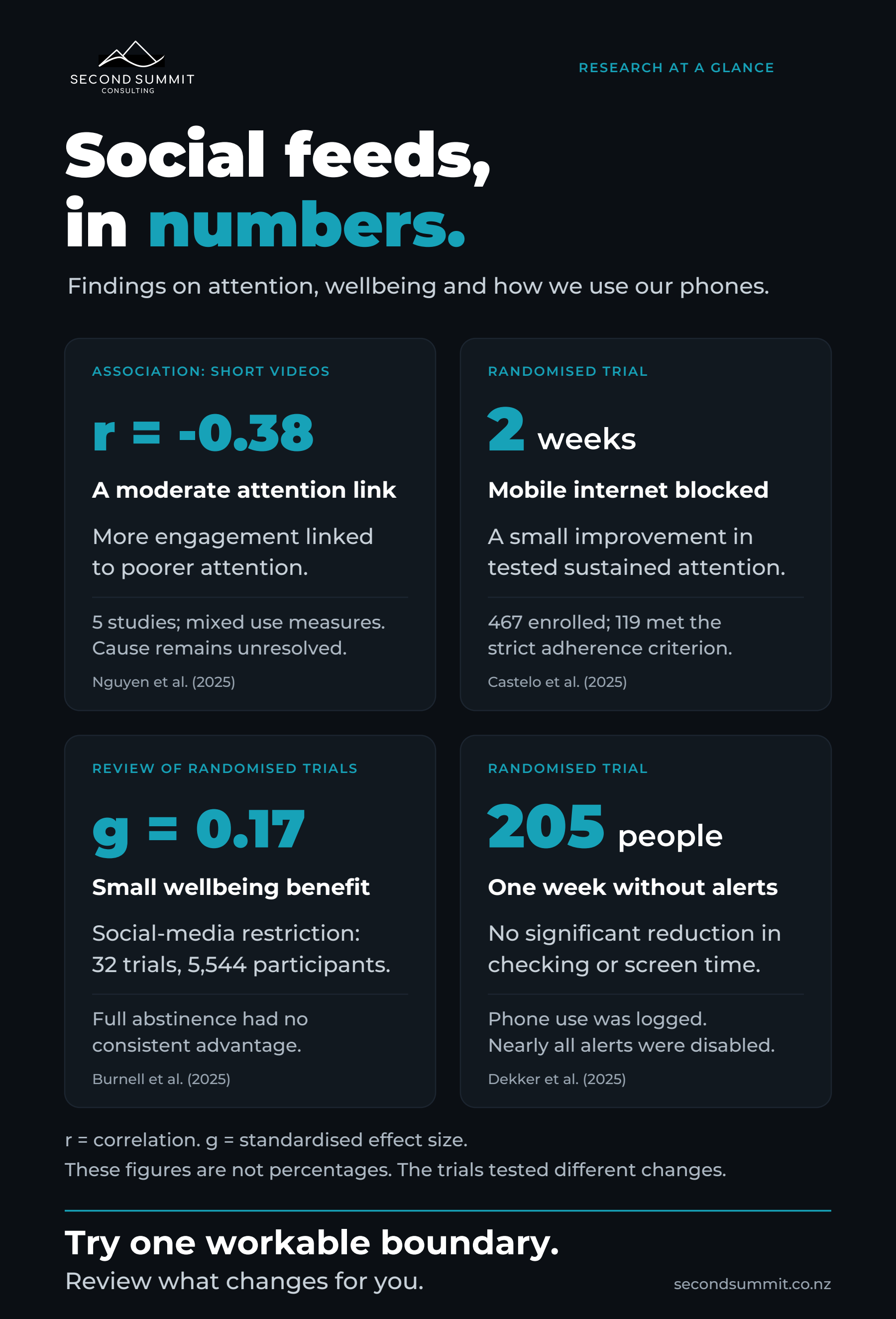
Nguyen et al. (2025) combined 71 studies involving 98,299 participants. Fourteen studies contributed to the cognition analysis. Greater short-video engagement was associated with poorer cognitive outcomes, with attention and inhibitory control showing particularly strong associations. Inhibitory control is the ability to hold back a response that doesn't fit what you're trying to do.
Many studies measured problematic use, including difficulty controlling use, and most were correlational. Someone already struggling with attention might be more drawn to a rapidly changing feed. Use might also contribute to the difficulty. The review can't settle the direction, and results varied substantially between studies.
There are small experiments showing more immediate effects. Chiossi et al. (2023) found poorer prospective memory after a ten-minute TikTok interruption. Prospective memory means remembering to carry out an intention when the moment arrives. A later experiment by Barton and Smyth (2025) found that freely switching through short videos was followed by poorer accuracy on a similar task. Both studies were small, and their designs leave uncertainty about precisely what caused the changes.
The more direct evidence on sustained attention is mixed. Lin et al. (2024) ran an 18-day field experiment with 41 people, asking them to increase or decrease their video consumption. Changing consumption did not significantly affect most sustained-attention measures. That is a relevant result to keep alongside the concerning findings. The groups were very small, and 18 days gives us a limited view of a behaviour people may repeat for years.
We also need to be careful about extending these findings to everything done on a phone. Winbush et al. (2025) followed objectively logged phone use in 10,099 US adults for four weeks. Associations with daily mood were generally weak or absent. That study measured a different outcome, so it doesn't resolve the attention question.
For rapid, difficult-to-control feed use, the findings give me more reason for concern than reassurance. I would be cautious about giving it unrestricted access to the day. That judgement is narrower than a verdict on all social media: these studies don't add up the value of staying in touch with someone or finding useful professional connections.
What Happens When We Change Access?
One of the more useful experiments here is Castelo et al. (2025). They enrolled 467 people in a randomised trial of blocking mobile internet for two weeks. Calls and texts remained available, and participants could still use the internet on other devices.
Performance on an objective sustained-attention task improved modestly. That matters because the result went beyond people reporting that they felt more focused.
It was a demanding intervention. Only 119 participants met the study's strict compliance criterion, and many didn't complete all follow-ups. Most had joined wanting to reduce their phone use. It also blocked all mobile internet, so we can't identify a particular feed as the cause or assume a lighter restriction would produce the same result. The mechanism behind the attention improvement remains unresolved.
What about wellbeing? Burnell et al. (2025) combined 32 randomised studies involving 5,544 participants. Restricting social media produced a small average improvement in subjective wellbeing. They found no consistent evidence that complete abstinence or longer restrictions worked better.
A separate review by Lemahieu et al. (2025) found no significant average wellbeing benefit in its main analyses of abstinence studies. A sensitivity analysis suggested a small improvement in positive feelings. The reviews used different methods, and together they leave us with modest, variable effects.
So I wouldn't promise that reducing social media will transform how you feel. I would suggest that a manageable boundary is worth trying, especially if you can already see it taking time from something you care about. Complete abstinence has little appeal as a general recommendation when you have useful reasons to be there.
Make the Boundary Part of the Environment
Before changing anything, have a look at the last week's usage. How much time went into the app, and how much of that did you actually want to spend there? The app total may include useful messages, so give the number some context.
Then consider what it displaced. If scrolling moves bedtime from 10.30 to 11.15, with the same wake-up time, you've left yourself 45 fewer minutes in bed. We don't need to settle the attention-training question to decide whether that trade suited you.
For me, the practical response is to make access fit the life you want. If a feed regularly interrupts your work, arrange for it to be unavailable during that part of the day. If you value using it to keep in touch, leave a workable route for that.
Turning off notifications may be part of the arrangement, but check whether it changes anything. In a preregistered trial with 205 young adults, Dekker et al. (2025) found that disabling nearly all app notifications for a week did not significantly reduce logged checking or screen time. People reported less habitual checking, alongside more fear of missing out. A quiet phone can still be a phone you repeatedly pick up. Turning off notifications will help reduce interruptions from focus though.
The protocols below put the decision earlier, when you can choose the arrangement deliberately. They give you fewer moments in which you have to resist an available feed.
The Protocols
PROTOCOL 1: Put One Feed on a Schedule (Main Recommendation)
- What to do: Choose the feed you most often open without having planned to. Decide when you actually want access to it. A short session after lunch might fit your day; choose a time that serves a purpose.
- Set up the environment: Schedule an app and website blocker to keep that feed unavailable outside your chosen window. Include the browser route if that's where you tend to go when the app is blocked. Where practical, remove the phone app and use the service on a computer during the window instead.
- Keep useful access: Before starting, make sure necessary messages or work tasks have a workable route. That might be direct messaging or a separate work window. Adjust the boundary around real responsibilities.
- How long: Try it for seven days, then review. This is a convenient period for an experiment, with no claim that a week resets anything in the brain.
- What to notice: Compare actual use with what you intended. Did you get what you came for? Did browsing move to another app? If the arrangement created a genuine problem, note what access was missing and adjust it.
- Evidence: Restriction trials give modest support for trying a change. This particular schedule has not been tested by the cited studies. Choose it for practicality and judge whether it helps you use the platform as intended.
PROTOCOL 2: Protect Something You Want More Of
- What to do: Choose one part of the day you want to give to something else. It might be reading with your morning coffee or finishing the first focused work block.
- Set up the environment: Put the phone somewhere you would have to get up to retrieve it. Block the same feed on the computer if you'll be working there. Put what you want to use within reach, such as the book beside the coffee chair.
- How long: Use the same seven-day review point. Keep necessary communication available in a way that fits your responsibilities.
- What to notice: Did you spend the time as intended? Did the arrangement make that easier? If the feed was providing a break, make room for a break you want to take. Notice whether the browsing simply moved into the evening.
- Evidence and limits: The attention and memory findings give a reason to examine interruptions. They didn't test this protocol. Your observations can help you choose a useful arrangement, although changes in sleep or workload may also affect the week.
Close
I think the early evidence gives us enough reason to look closely at automatic feed use. There is still plenty we don't know about lasting effects on attention. We can acknowledge that uncertainty and make a considered decision about how much access we want these platforms to have.
In the habit piece, the change my wife and I chose was to put the books where we have our coffee. I would bring the same approach here. Make room for the thing you want to do, and set up your surroundings so that following through is a little easier. Environmental design trumps will power. Every time.
Keep the uses you value. Give the browsing a place and a stopping point. After a week, see whether the arrangement has earned its place in your day.
I'd love to hear what you try. Which boundary did you choose, and what did you notice? Drop a note in the comments or send me an email, including if it made little difference.